


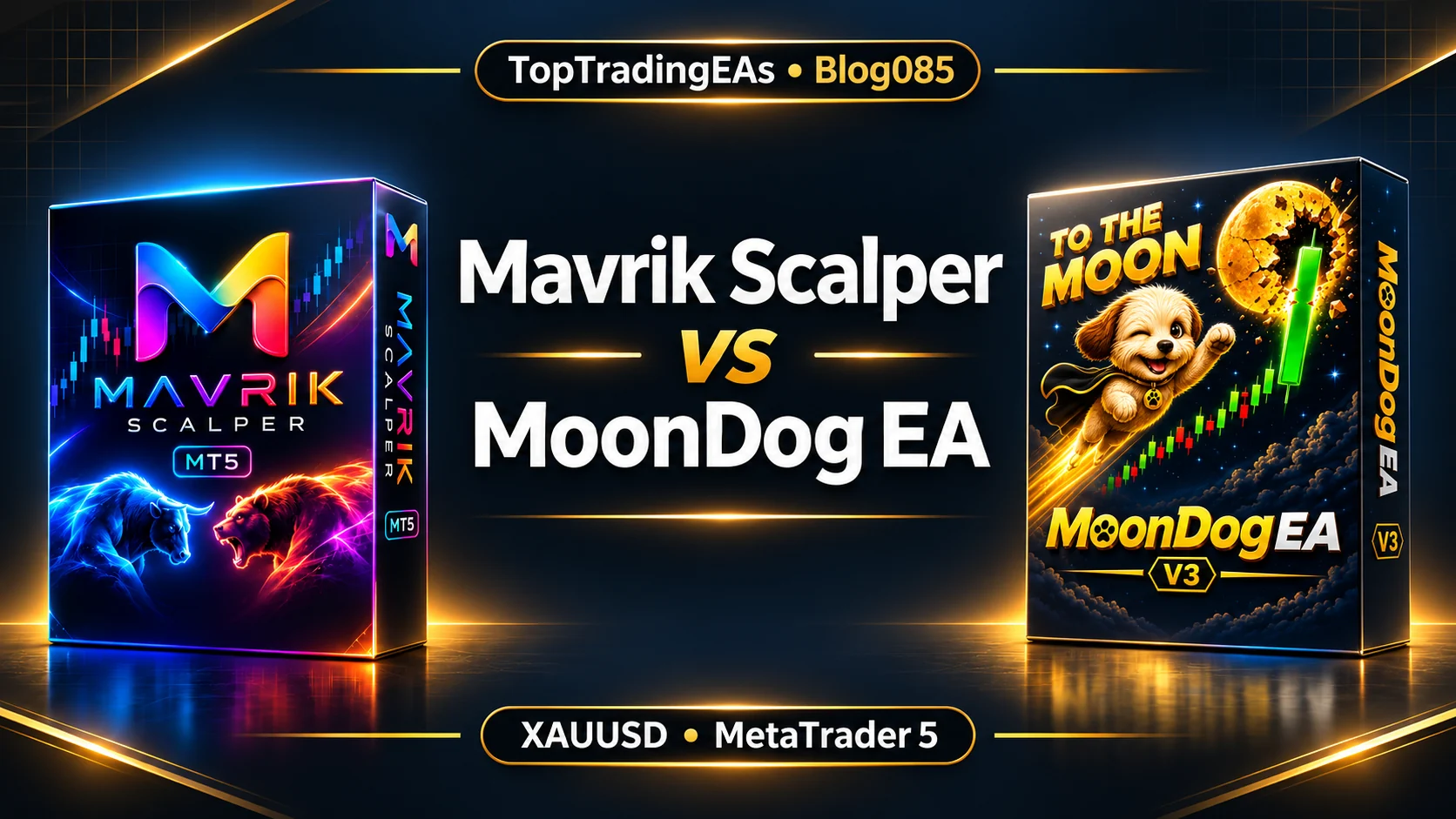
Mavrik Scalper vs MoonDog EA MT5: Scalping and Breakouts
Mavrik Scalper vs MoonDog EA MT5: Scalping and Breakouts
Mavrik Scalper vs MoonDog EA MT5 compares two ways of selecting XAUUSD opportunities without relying on a recovery grid in their documented descriptions. Mavrik focuses on selective short-term entries on M5. MoonDog offers several breakout modules with optional ONNX filtering. Their practical differences include trade clustering, stop management and the configuration choices behind each report, rather than simply the presence of an AI label.
Original review videos
Watch the two source reviews for setup and historical evidence; these are separate reviews rather than a new matched test.
Mavrik Scalper
MoonDog EA
How Mavrik Scalper trades XAUUSD
Mavrik’s developer describes a trained Hybrid Attention neural model that evaluates short-term gold behavior and waits for its confidence conditions. The proprietary model and its thresholds are not independently exposed in the review. What can be checked is whether the EA waits, when positions cluster and how they are sized and closed after a signal qualifies.
The documented setup recommends XAUUSD M5 and a hedging account. Up to four positions can remain open simultaneously. Each starts with predefined Stop Loss and Take Profit; break-even, trailing, time-based and news-related protections are available. The developer describes no martingale, grid trading or averaging. Several individually stopped positions can still share the same market direction and lose together.
The review’s six-month report includes 905 trades. Its average winning trade was 2.18, compared with an average losing trade of 38.03 in report currency. That asymmetry makes the frequency and size of losses particularly important. A quiet session does not by itself indicate a fault, and a run of small winners does not establish that the next cluster has little downside.
Read the original Mavrik Scalper review and settings.
How MoonDog EA selects and manages breakout trades
MoonDog is described as a multi-strategy XAUUSD breakout engine running from one chart. Five original strategies can be used alone or expanded with four optional additions. The developer specifies individual initial stops and targets, with no recovery grid, martingale or larger trades after a loss. Module count is a configuration choice, not evidence that the resulting positions are uncorrelated.
Optional ONNX modes can alter selection, while fixed lots, percentage-based risk and ONNX-score adaptive sizing can alter exposure. The historical main screenshots identify build 3.34 on H1. Record the active strategy list and sizing method before trying to connect its results to an advertised mode. The complete input file is more useful than assuming every available protection was enabled.
MoonLock can protect eligible floating profit, with an adaptive variant tailored to different strategies. News, spread and weekend controls add operating choices. For a comparison with Mavrik, focus on how a qualifying breakout becomes a managed trade: initial protection, time spent open, changes to the exit and exposure from other modules entering nearby.
Read the original MoonDog EA review and settings.
Backtest conditions and report comparison
The Mavrik Scalper column is its six-month report; MoonDog is its main historical run, not a verified matching period. Both initial deposits display 1,000 account units. History quality displays 100%. Equal lot risk, account currency, commission, spreads and slippage are not confirmed. MoonDog’s exact main-run start and end dates are not visible in this report screenshot.
| Report metric | Mavrik Scalper · six months | MoonDog · main run |
|---|---|---|
| Chart timeframe | M5 | H1 |
| Net profit (report currency) | 1,705.07 | 572,221.20 |
| Relative equity drawdown | 6.53% | 17.44% |
| Profit factor | 7.68 | 5.92 |
| Winning trades | 99.34% | 76.27% |
| Total trades | 905 | 236 |
Mavrik’s six-month report shows 6.53% relative equity drawdown and a profit factor of 7.68. Its 99.34% win rate describes that sample; it does not remove the effect of occasional larger losses. The one-month report shows 100% winners across 210 trades. A month without a completed losing trade is especially weak evidence for the loss size to expect later.
MoonDog’s main run records 236 trades, 76.27% winners and a profit factor of 5.92. Comparing these figures makes the payoff structures visible, but does not normalize risk. The tests use different configurations and periods. MoonDog’s much larger compounded profit should be read with its equity curve and changing exposure, rather than treated as a forecast or a reason to increase lot size.
Broker and account checks before backtesting
Compare the actual gold symbol, contract size, tick value, minimum lot, lot step, commission and spread. The linked broker comparison concerns its own Quantum Queen observation; it does not establish the best broker for this pair. For eligible FxPro Nano accounts, check the exact currency and symbol specifications before using any preset. Availability and compatibility require confirmation with the broker.
Referral disclosure: TopTradingEAs may receive compensation through the broker links.
Historical equity charts and original tester reports
Compare Mavrik’s one-month and six-month curves for periods of clustering and infrequent losses. Then read MoonDog’s main and validation curves separately. The validation report has 71 trades and a profit factor of 5.88. Four charts give context about their historical behavior, but their differing samples cannot establish which model generalizes better to the next gold-market regime.
Mavrik Scalper one-month XAUUSD M5 test


Mavrik Scalper six-month XAUUSD M5 test


MoonDog EA main run


MoonDog EA validation run


Forward-trading screenshots
These monitoring snapshots are separate from the tester runs. Check the visible dates, strategy rows and account activity. Shared-account totals, deposits and other EA trades cannot be attributed to one bot; the images do not establish a continuous independently verified track record.
Mavrik Scalper

View More Forward Trading Results
MoonDog EA

Settings and trade-history checks for this pair
Execution costs matter most when interpreted relative to the trade being captured. Mavrik’s average winning trade in the six-month sample was small in account-currency terms. That makes the report’s cost assumptions worth checking carefully. It does not prove that another broker will erase the result, because lot sizes, contract values and the exact commission schedule also matter.
For both EAs, compare entry time, requested price, actual price, volume and final commission in a demo journal. Group entries that occur close together so you can see the whole cluster. A small amount of slippage on one trade is a different observation from several same-direction entries all filling during a widening spread.
Keep the position-sizing method fixed during this check. Otherwise a larger total profit can come from more volume instead of improved selection. With MoonDog, preserve the strategy and ONNX settings too; with Mavrik, preserve the model configuration and maximum-position behavior. That gives execution observations an identifiable context.
Selective scalping, clustered positions and breakout risk: what to check in a demo log
For Mavrik, reconstruct the maximum four-position cluster in a demo log. Record direction, lots, initial stops, entry spacing and commission. The relevant risk is the combined loss if the active trades move against you together. Do not multiply a winning percentage by the account balance or assume that four entries represent four independent forecasts.
For MoonDog, use strategy labels to identify entries responding to the same breakout. Compare the holding time and exit changes with Mavrik’s trades. Both approaches can depend on execution quality around fast moves. Repeat the comparison with realistic commission and spread assumptions, keeping risk constant before changing model modes. This separates a signal-selection question from a lot-sizing question.
Questions about Mavrik Scalper vs MoonDog EA
Does Mavrik trade continuously on M5?
No. Its description emphasizes selective confidence-based entries. Inactivity can be normal, while qualifying conditions can create several entries close together.
Which EA has less risk because it uses individual stops?
Individual stops define trade-level exits, but account risk also depends on lots, simultaneous positions, gaps and fills. The historical drawdowns are observations for their own settings.
Should I copy Mavrik settings directly into MoonDog?
No. Inputs with similar names may govern different entry and sizing processes. Establish a separate documented configuration and test log for each EA.
Mavrik Scalper vs MoonDog EA: practical verdict
Mavrik is the more focused research candidate for M5 selection, clustered entries and a high-win-rate payoff structure. MoonDog offers a broader module and profit-protection configuration. Compare their loss episodes and aggregate exposure before their headline profits. The better fit is the configuration whose execution and risk you can reproduce under your own broker conditions.
Continue the comparison
Compare Mavrik Scalper with Gold Reaper; compare MoonDog EA with Gold Reaper.
Build your own MT5 EA or connect your trading accounts
BYO-Bot is Windows software for building and testing MT5 strategies without coding. Explore cTrader Copier for MT5-to-MT5 and MT5-to-cTrader copying, and check the landing page for current plans and setup requirements.
Trading risk
Automated gold trading can lose capital. Historical backtests and monitoring screenshots do not guarantee future performance. Evaluate the exact build, settings and broker conditions before using a configuration.