


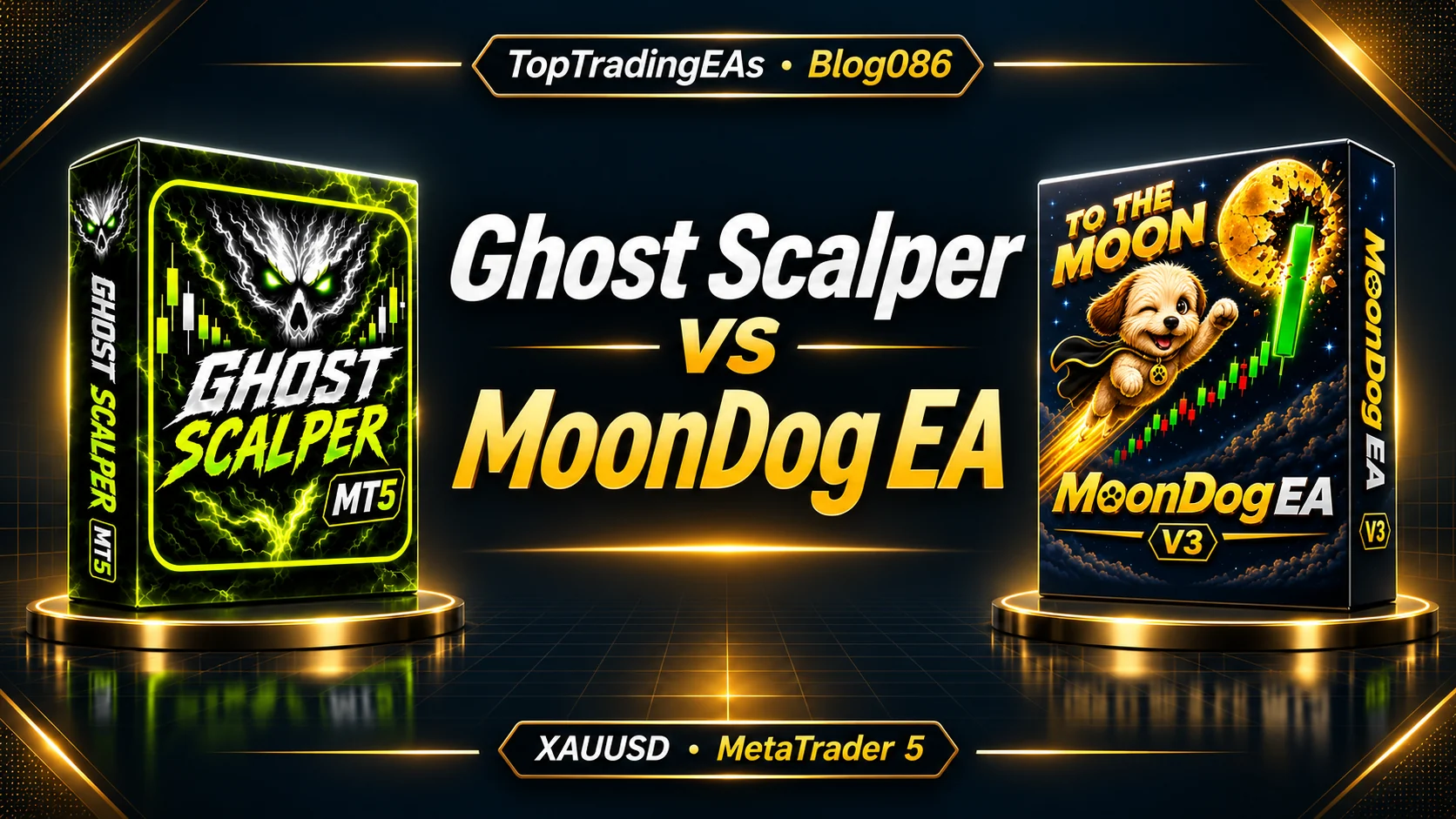
Ghost Scalper vs MoonDog EA MT5: Entries, Exits and Risk
Ghost Scalper vs MoonDog EA MT5: Entries, Exits and Risk
Ghost Scalper vs MoonDog EA MT5 is a comparison of breakout execution and position management, despite the word scalper in Ghost’s name. Both documented systems use several XAUUSD strategies. Ghost emphasizes configurable modules and pending entries; MoonDog adds optional ONNX selection and MoonLock profit protection. The useful question is how the enabled strategies turn a price condition into an actual fill and an eventual exit.
Original review videos
Watch the two source reviews for setup and historical evidence; these are separate reviews rather than a new matched test.
Ghost Scalper
MoonDog EA
How Ghost Scalper trades XAUUSD
Ghost Scalper’s review recommends H1 and describes four modules: Ghost A, B, C and D. Each can be enabled separately with its own risk and management settings. The system waits for eligible breakout or momentum conditions instead of requiring continuous market participation. Its exact internal thresholds remain proprietary and should not be inferred from the product name.
When a setup qualifies, Ghost can calculate a buy or sell pending entry and update the level as conditions change. Activation depends on price reaching the order condition. A pending order is not a guaranteed fill at the intended price, particularly around gaps or sharp moves. Check requested levels and actual entry prices in the order history rather than reading the line on a chart as the execution result.
Activated trades can use Stop Loss, Take Profit and automatic trailing, with internal monitoring. Independent module controls do not establish a whole-account exposure ceiling. Several modules may react to the same move in gold. The review’s 666-trade six-month sample is useful for studying that behavior, but it does not disclose every possible order interaction or certify a future drawdown limit.
Read the original Ghost Scalper review and settings.
How MoonDog EA selects and manages breakout trades
MoonDog’s description combines five original breakout strategies, with four optional additions available from one MT5 chart. It describes an initial Stop Loss and Take Profit for each trade and excludes recovery grids, averaging and martingale. The main report identifies build 3.34 on H1. A feature described in the current overview should not automatically be assumed active in that historical build or preset.
ONNX can be disabled or used through Conservative and More Trades configurations. Sizing can be fixed, percentage-based or optionally informed by the ONNX score. These are separate choices from how many modules are enabled. To compare with Ghost’s module-specific risk, record both the strategy selection and the exposure method, including the total lots open when another strategy qualifies.
MoonLock is an additional profit-protection process after activation. Its adaptive variant tailors management to strategies. Ghost’s trailing controls and MoonDog’s MoonLock should therefore be examined through actual stop changes and closes, rather than treated as interchangeable because both may protect a favorable move. Record the initial protection and the final exit for several failed and successful breakouts.
Read the original MoonDog EA review and settings.
Backtest conditions and report comparison
The Ghost Scalper column is its six-month report; MoonDog is its main historical run, not a verified matching period. Both initial deposits display 1,000 account units. History quality displays 100%. Equal lot risk, account currency, commission, spreads and slippage are not confirmed. MoonDog’s exact main-run start and end dates are not visible in this report screenshot.
| Report metric | Ghost Scalper · six months | MoonDog · main run |
|---|---|---|
| Chart timeframe | H1 | H1 |
| Net profit (report currency) | 2,889.66 | 572,221.20 |
| Relative equity drawdown | 0.84% | 17.44% |
| Profit factor | 20.65 | 5.92 |
| Winning trades | 82.73% | 76.27% |
| Total trades | 666 | 236 |
Ghost’s six-month report records 0.84% relative equity drawdown, a profit factor of 20.65 and 82.73% winning trades. The one-month report records 0.91% relative equity drawdown. These unusually small historical drawdowns deserve inspection of the exact configuration, trade sizes and equity history. They cannot be promoted to an account-loss promise or transferred to another module combination.
MoonDog’s main report records 17.44% relative equity drawdown and 236 trades, while its validation report records 10.59% and 71 trades. The samples are not a matched experiment. Compare the stop behavior, simultaneous positions and report labels before treating the difference as a property of the underlying strategy. Profit factor also belongs to the period and risk path that produced it.
Broker and account checks before backtesting
Compare the actual gold symbol, contract size, tick value, minimum lot, lot step, commission and spread. The linked broker comparison concerns its own Quantum Queen observation; it does not establish the best broker for this pair. For eligible FxPro Nano accounts, check the exact currency and symbol specifications before using any preset. Availability and compatibility require confirmation with the broker.
Referral disclosure: TopTradingEAs may receive compensation through the broker links.
Historical equity charts and original tester reports
The four chart/report pairs below separate Ghost’s one-month and six-month tests from MoonDog’s main and validation runs. Use the equity curve to locate adverse sequences, then inspect their numerical report. Small relative drawdown and a large recovery factor are not substitutes for identifying the lots and trades responsible for a result.
Ghost Scalper one-month XAUUSD H1 test


Ghost Scalper six-month XAUUSD H1 test


MoonDog EA main run


MoonDog EA validation run


Forward-trading screenshots
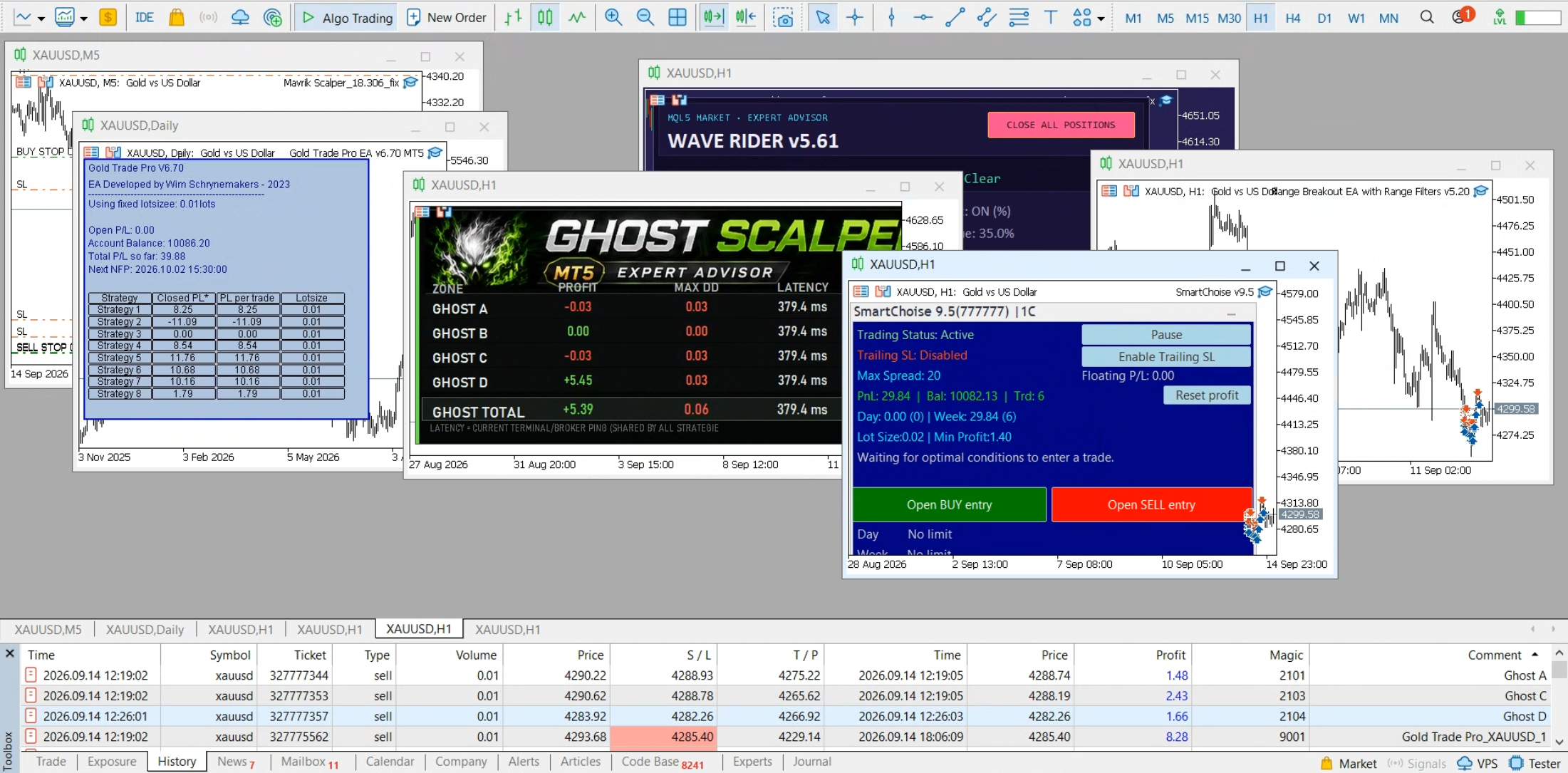
These monitoring snapshots are separate from the tester runs. Check the visible dates, strategy rows and account activity. Shared-account totals, deposits and other EA trades cannot be attributed to one bot; the images do not establish a continuous independently verified track record.
Ghost Scalper
View More Forward Trading Results
MoonDog EA

Settings and trade-history checks for this pair
A pending entry introduces a period during which an order exists but no market position has opened. Ghost can revise an eligible level as conditions develop. Distinguish an order cancellation or amendment from a rejected trade, and distinguish a delayed trigger from an EA that has stopped operating. The Experts log and order history can answer those questions together.
After activation, trace the position separately. Record which module owned it, where the stop began and what trailing changed. Do not infer that a pending price shown earlier was the final entry. A gap or fast move can separate the trigger condition from the price actually received.
For MoonDog, identify the order behavior of the exact preset rather than assuming all modules share Ghost’s entry process. Its report screenshot includes a pending-stop example, but one visible order does not establish the implementation of every strategy. Use the trade comments, settings and history to connect each observation to its module.
Pending breakout entries and multi-strategy exits: what to check in a demo log
A useful pending-order audit begins before the fill. Record each Ghost module’s requested price, revisions, activation, initial stop and actual entry. Match these observations with the broker’s spread and trading session. This reveals whether a missed or shifted entry came from strategy conditions, an amended order or execution. Apply the same requested-versus-filled check to the documented MoonDog configuration.
Next compare exits without changing the module list. For Ghost, log trailing adjustments; for MoonDog, log MoonLock activation and subsequent close. Two trades entering near the same price can finish differently because management reacts differently to a retracement. Once that is understood, test additional strategies separately. Enabling more modules changes overlap and can obscure what an exit change actually achieved.
Questions about Ghost Scalper vs MoonDog EA
Is Ghost Scalper only a constant-entry scalper?
No. The reviewed H1 system waits for selective breakout and momentum conditions across four independently configured modules, and can use pending orders.
Does MoonDog have the same four modules as Ghost?
No. MoonDog describes five original strategies plus four optional additions. Similar breakout terminology does not establish identical triggers or trade management.
Does Ghost’s 0.84% drawdown establish a safe risk setting?
No. It is the relative equity drawdown observed in one historical report. Different lots, modules, execution and market conditions can produce a different loss path.
Ghost Scalper vs MoonDog EA: practical verdict
This pair is strongest as an investigation of pending entries, module overlap and exits. Ghost makes its four-module controls central to the comparison, while MoonDog adds selectable filtering and MoonLock. Start with a documented preset and trace individual trades. A clearly explained entry-to-exit sequence is more useful than choosing the smallest drawdown in unmatched reports.
Continue the comparison
Compare Ghost Scalper with Gold Reaper; compare MoonDog EA with Gold Reaper.
Build your own MT5 EA or connect your trading accounts
BYO-Bot is Windows software for building and testing MT5 strategies without coding. Explore cTrader Copier for MT5-to-MT5 and MT5-to-cTrader copying, and check the landing page for current plans and setup requirements.
Trading risk
Automated gold trading can lose capital. Historical backtests and monitoring screenshots do not guarantee future performance. Evaluate the exact build, settings and broker conditions before using a configuration.