


SmartChoise vs MoonDog EA MT5: Recovery and Breakout Risk
SmartChoise vs MoonDog EA MT5: Recovery and Breakout Risk
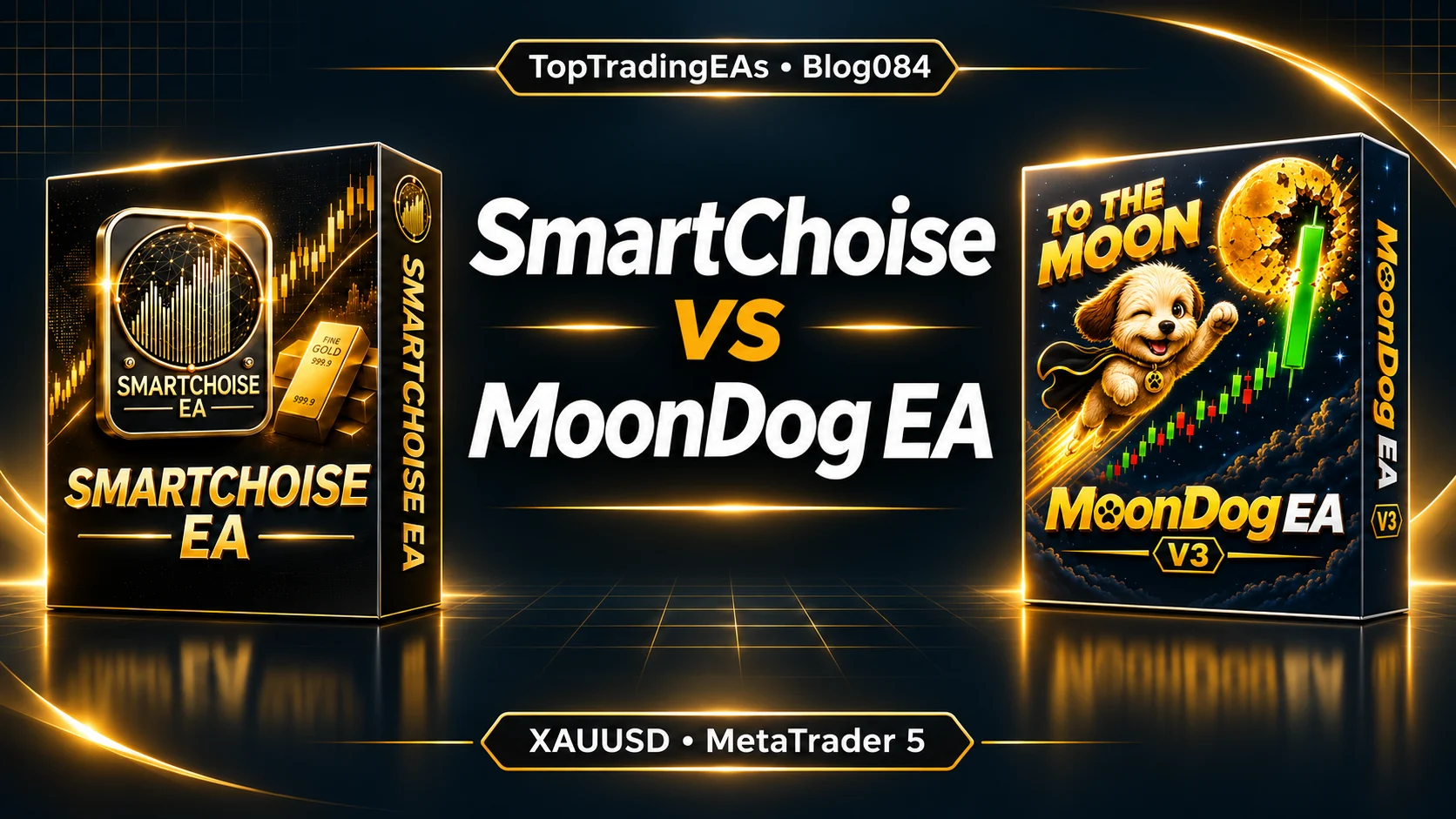
SmartChoise vs MoonDog EA MT5 is a useful comparison for traders deciding how they want a gold robot to handle an unsuccessful entry. SmartChoise combines entry selection with dynamic sizing and recovery management. MoonDog describes breakout modules with individual trade exits and optional profit protection. The important question is how exposure develops after entry, rather than which historical balance finishes highest.
Original review videos
Watch the two source reviews for setup and historical evidence; these are separate reviews rather than a new matched test.
SmartChoise
MoonDog EA
How SmartChoise trades XAUUSD
SmartChoise’s developer describes a neural-network-based entry engine, with optional support-and-resistance and candlestick strategies. The model’s architecture and exact scoring thresholds are proprietary. Optional entry modules should be logged separately because enabling another signal can change trade frequency and overlap, even when the selected risk profile stays unchanged.
Low, Medium, High and Extreme profiles sit alongside Conservative and Aggressive styles. Dynamic sizing and advanced recovery make the complete configuration more informative than either label. The developer describes recovery as non-martingale, but that does not establish constant exposure. Check subsequent order sizes, the number of active positions and whether the first losing trade remains open while recovery continues.
The review identifies spread and news controls, virtual trailing and hard-stop options. Their presence in the feature list does not confirm their activation. Record which protections are broker-side and which depend on the terminal. The historical six-month report identifies v9.5 on H1, while the product description discusses v9.6 and M1. Do not treat the H1 result as a test of the later M1 configuration.
Read the original SmartChoise review and settings.
How MoonDog EA selects and manages breakout trades
MoonDog’s documented approach starts with multiple XAUUSD breakout modules running from one MT5 chart. Five original strategies can be expanded with four optional additions. The developer describes initial Stop Loss and Take Profit for each trade, without recovery grids, loss averaging or increased trade size after a loss. Several strategies can nevertheless respond to the same gold move.
ONNX filtering is optional, with Conservative and More Trades modes. Fixed lots, percentage-based risk and optional ONNX-score sizing are different choices. Adaptive sizing is described as signal-based, not recovery-based. The main screenshots identify build 3.34 on H1; the broader feature list does not prove which optional modules or modes were active in that run.
MoonLock protects eligible floating profit after activation; Adaptive MoonLock can vary management between strategies. This changes the exit of a favorable trade. It should not be confused with a mechanism for repairing a losing basket. For this pair, record the initial stop and the point where MoonLock activates, then compare that sequence with a SmartChoise recovery episode.
Read the original MoonDog EA review and settings.
Backtest conditions and report comparison
The SmartChoise column is its six-month report; MoonDog is its main historical run, not a verified matching period. Both initial deposits display 1,000 account units. History quality displays 100%. Equal lot risk, account currency, commission, spreads and slippage are not confirmed. MoonDog’s exact main-run start and end dates are not visible in this report screenshot.
| Report metric | SmartChoise · six months | MoonDog · main run |
|---|---|---|
| Chart timeframe | H1 | H1 |
| Net profit (report currency) | 5,495.15 | 572,221.20 |
| Relative equity drawdown | 6.92% | 17.44% |
| Profit factor | 21.95 | 5.92 |
| Winning trades | 99.54% | 76.27% |
| Total trades | 1,520 | 236 |
The SmartChoise six-month report combines 1,520 trades, 99.54% winners and a profit factor of 21.95. Those observations belong to that configuration. A high win rate can coexist with a small number of large losses; the review flags this asymmetry. Read the losing sequences and floating equity alongside the profitable closes before judging how forgiving the recovery settings appear.
MoonDog’s main report records 236 trades and 17.44% relative equity drawdown. Its large compounded profit is not a fair shortcut to a ranking. The periods, sizing paths and exposure assumptions are not standardized. Recovery versus per-trade exits remains the stronger comparison because it tells you what behavior to investigate when the market moves against an entry.
Broker and account checks before backtesting
Compare the actual gold symbol, contract size, tick value, minimum lot, lot step, commission and spread. The linked broker comparison concerns its own Quantum Queen observation; it does not establish the best broker for this pair. For eligible FxPro Nano accounts, check the exact currency and symbol specifications before using any preset. Availability and compatibility require confirmation with the broker.
Referral disclosure: TopTradingEAs may receive compensation through the broker links.
Historical equity charts and original tester reports
SmartChoise’s one-month and six-month charts offer different sample lengths, not two independent guarantees. Compare the shape of equity during recovery with the matching report. MoonDog’s validation run records 71 trades and 10.59% relative equity drawdown; it is a separate sample. Neither validation nor an attractive main curve establishes the future size of a losing sequence.
SmartChoise EA one-month XAUUSD test


SmartChoise EA six-month XAUUSD test


MoonDog EA main run


MoonDog EA validation run


Forward-trading screenshots
These monitoring snapshots are separate from the tester runs. Check the visible dates, strategy rows and account activity. Shared-account totals, deposits and other EA trades cannot be attributed to one bot; the images do not establish a continuous independently verified track record.
SmartChoise

View More Forward Trading Results
MoonDog EA

Settings and trade-history checks for this pair
Compare recovery settings through a sequence, not just a final balance. Pick an adverse interval in the SmartChoise equity curve, then identify the entry that began it. Separate realized losses from positions still open. If later trades close a recovery pair or change the basket exposure, record that effect rather than counting every profitable close as an unrelated successful forecast.
For MoonDog, inspect the same kinds of adverse intervals through strategy comments and individual exits. An initial stop and a later profit-locking action answer different questions. Record how much risk existed before any protection activated, and whether several modules were exposed at that point. An account can still experience a losing cluster even when each position has an exit.
This distinction also changes what you monitor during a quiet period. A terminal with no new entries may be flat, or it may still carry old recovery exposure. Check open positions, equity and available margin together before concluding that either EA is inactive.
Recovery exposure versus breakout exits: what to check in a demo log
Build a recovery log for SmartChoise: first entry, subsequent entries, lots, maximum simultaneous exposure and final close. Build a trade-exit log for MoonDog: strategy label, initial stop, target, MoonLock changes and realized fill. Compare the largest exposed amount during each episode. An equal opening lot does not create equal risk when the management paths diverge.
Test one configuration change at a time. Changing SmartChoise’s entry modules and recovery settings together makes the cause of a result difficult to identify. With MoonDog, switching from five to nine strategies while changing ONNX sizing has the same problem. Keep the risk profile, module list and exit settings with every report rather than relying on a familiar preset name.
Questions about SmartChoise vs MoonDog EA
Does non-martingale mean SmartChoise has no recovery risk?
No. The developer distinguishes its recovery logic from martingale, while the review documents adaptive exposure management. Inspect the actual order sequence and limits; the label does not establish a maximum account loss.
Does MoonLock replace MoonDog’s initial Stop Loss?
The description presents MoonLock as additional profit protection after activation. Initial trade protection and subsequent profit locking are separate parts of the configuration.
Can the six-month SmartChoise result predict MoonDog performance?
No. Different systems, dates, modules and sizing prevent that inference. Reproduce a common test setup if you want a new performance comparison.
SmartChoise vs MoonDog EA: practical verdict
SmartChoise offers the more relevant investigation if you want to understand recovery-based exposure and dynamic sizing. MoonDog offers a different investigation around breakout modules and individual exits. Choose the behavior you can explain and monitor, then validate the exact build and preset. The historical reports help frame those checks; they do not select a universal winner.
Continue the comparison
Compare SmartChoise with Gold Reaper; compare MoonDog EA with Gold Reaper.
Build your own MT5 EA or connect your trading accounts
BYO-Bot is Windows software for building and testing MT5 strategies without coding. Explore cTrader Copier for MT5-to-MT5 and MT5-to-cTrader copying, and check the landing page for current plans and setup requirements.
Trading risk
Automated gold trading can lose capital. Historical backtests and monitoring screenshots do not guarantee future performance. Evaluate the exact build, settings and broker conditions before using a configuration.