



NeonGamer vs MoonDog EA MT5: Grid Baskets and Stop Losses
NeonGamer vs MoonDog EA MT5: Grid Baskets and Stop Losses
NeonGamer vs MoonDog EA MT5 compares two different responses to an adverse gold move. NeonGamer can add ATR-spaced positions and manage them toward a basket target. MoonDog describes individually protected breakout trades without recovery averaging. Their entries both involve selection, but the larger distinction appears after a position is open: whether more exposure can be added to the same basket or the trade follows its own exit.
Original review videos
Watch the two source reviews for setup and historical evidence; these are separate reviews rather than a new matched test.
NeonGamer
MoonDog EA
How NeonGamer trades XAUUSD
NeonGamer’s documented M15 setup filters the first XAUUSD entry through several conditions. Three EMAs assess alignment across two timeframes; ADX checks strength; tick volume and candle body check participation and direction. ATR, spread and session conditions also affect whether a new basket starts. The exact thresholds are not all established by the review.
If price moves against the initial trade, additional entries can be placed at ATR-derived distances. The basket’s average entry changes as positions are added, and the group seeks a configured profit objective. Wider spacing may delay additions during higher volatility. It does not establish a maximum number of positions, fixed total risk or a guaranteed retracement. Review spacing together with lot sizing and any order limits.
NeonGamer offers fixed or automatic balance-based sizing and a daily drawdown control. Blocking new entries at a loss threshold and closing existing positions are separate behaviors. Record whether immediate closing is enabled. A paused grid can still carry floating loss, so a daily entry block should not be described as an automatic liquidation or a guaranteed cap on the final realized loss.
Read the original NeonGamer review and settings.
How MoonDog EA selects and manages breakout trades
MoonDog’s developer describes a gold breakout framework with five original strategies and four optional additions, running from one chart. Each trade starts with its own Stop Loss and Take Profit. The description excludes recovery grids, loss averaging and larger trades after a loss. More than one module may still trade together, so individual protection does not eliminate correlated XAUUSD exposure.
Fixed lots, percentage-based risk and optional ONNX-score adaptive sizing are alternative settings. ONNX filtering also has separate Conservative and More Trades modes. The main historical screenshots identify build 3.34 on H1; they do not establish that every advertised feature was active. Keep the input file and enabled strategy list with the report when comparing it with NeonGamer’s M15 basket configuration.
MoonLock can protect eligible floating profit after activation, with an adaptive variant for different strategies. It is not a basket recovery target. The distinction matters during a retracement: NeonGamer may manage several entries toward an average-price objective, while MoonDog’s documented approach manages the protection and exit of each breakout trade.
Read the original MoonDog EA review and settings.
Backtest conditions and report comparison
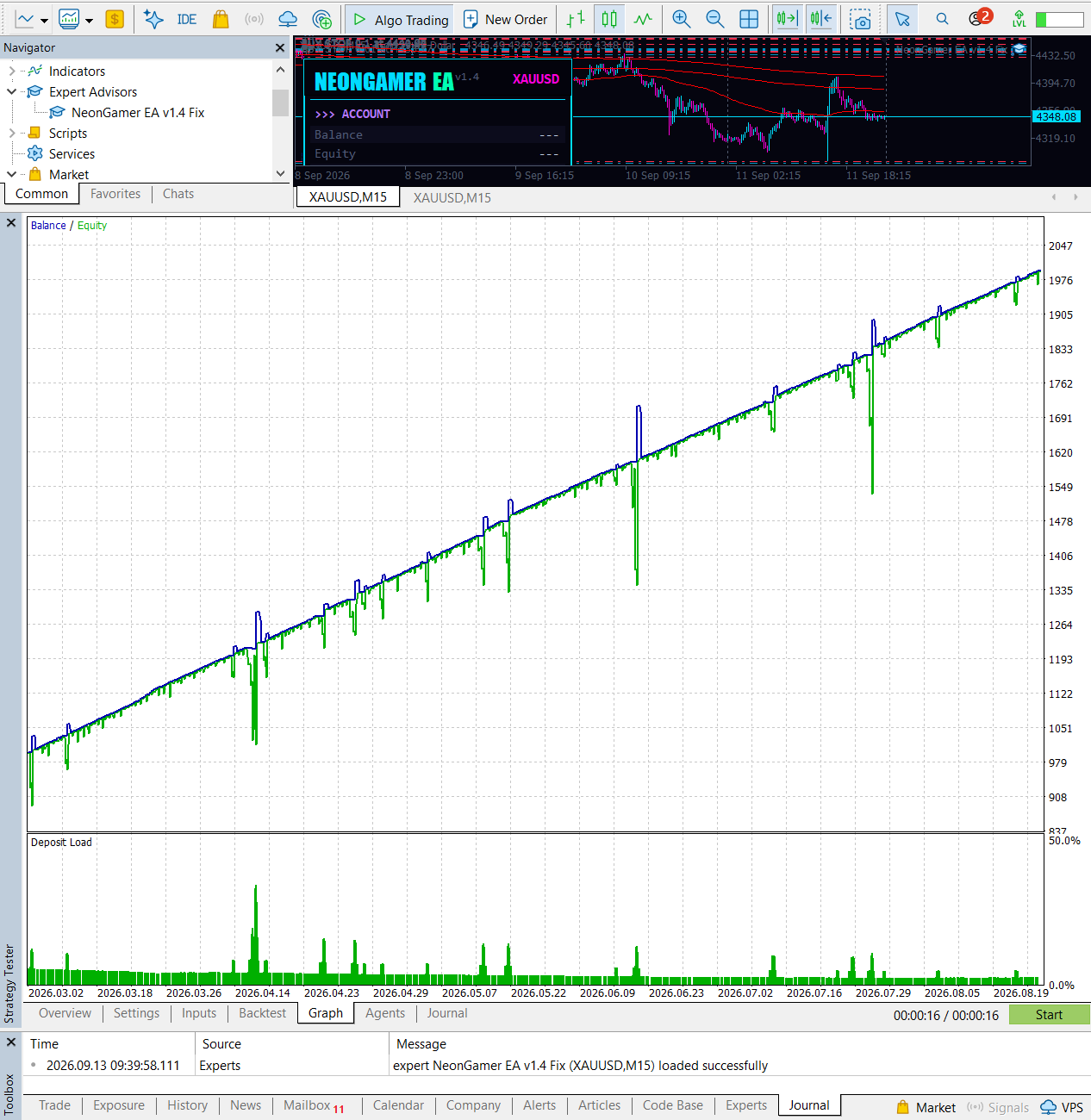
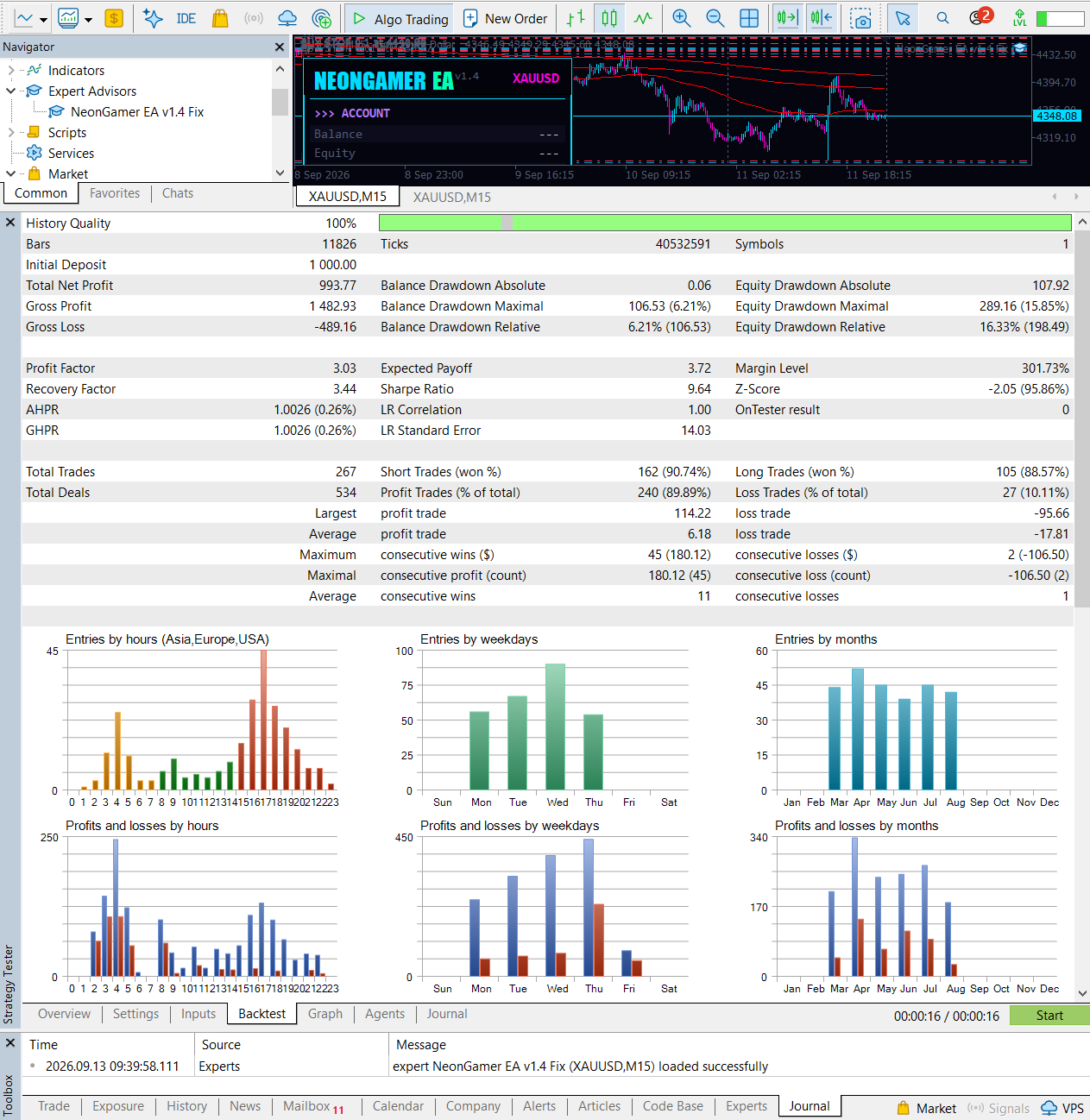
The NeonGamer column is its six-month report; MoonDog is its main historical run, not a verified matching period. Both initial deposits display 1,000 account units. History quality displays 100%. Equal lot risk, account currency, commission, spreads and slippage are not confirmed. MoonDog’s exact main-run start and end dates are not visible in this report screenshot.
| Report metric | NeonGamer · six months | MoonDog · main run |
|---|---|---|
| Chart timeframe | M15 | H1 |
| Net profit (report currency) | 993.77 | 572,221.20 |
| Relative equity drawdown | 16.33% | 17.44% |
| Profit factor | 3.03 | 5.92 |
| Winning trades | 89.89% | 76.27% |
| Total trades | 267 | 236 |
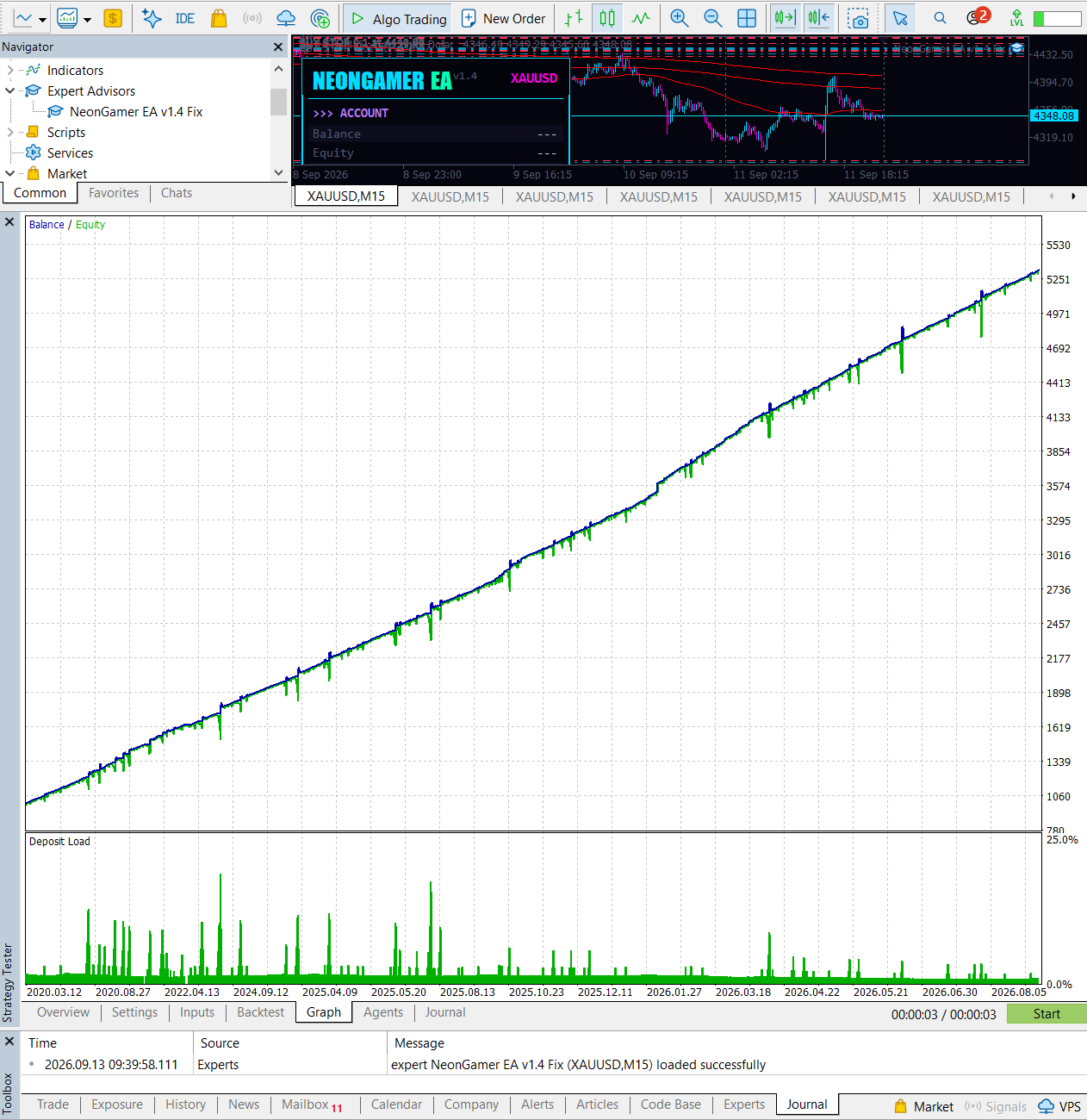
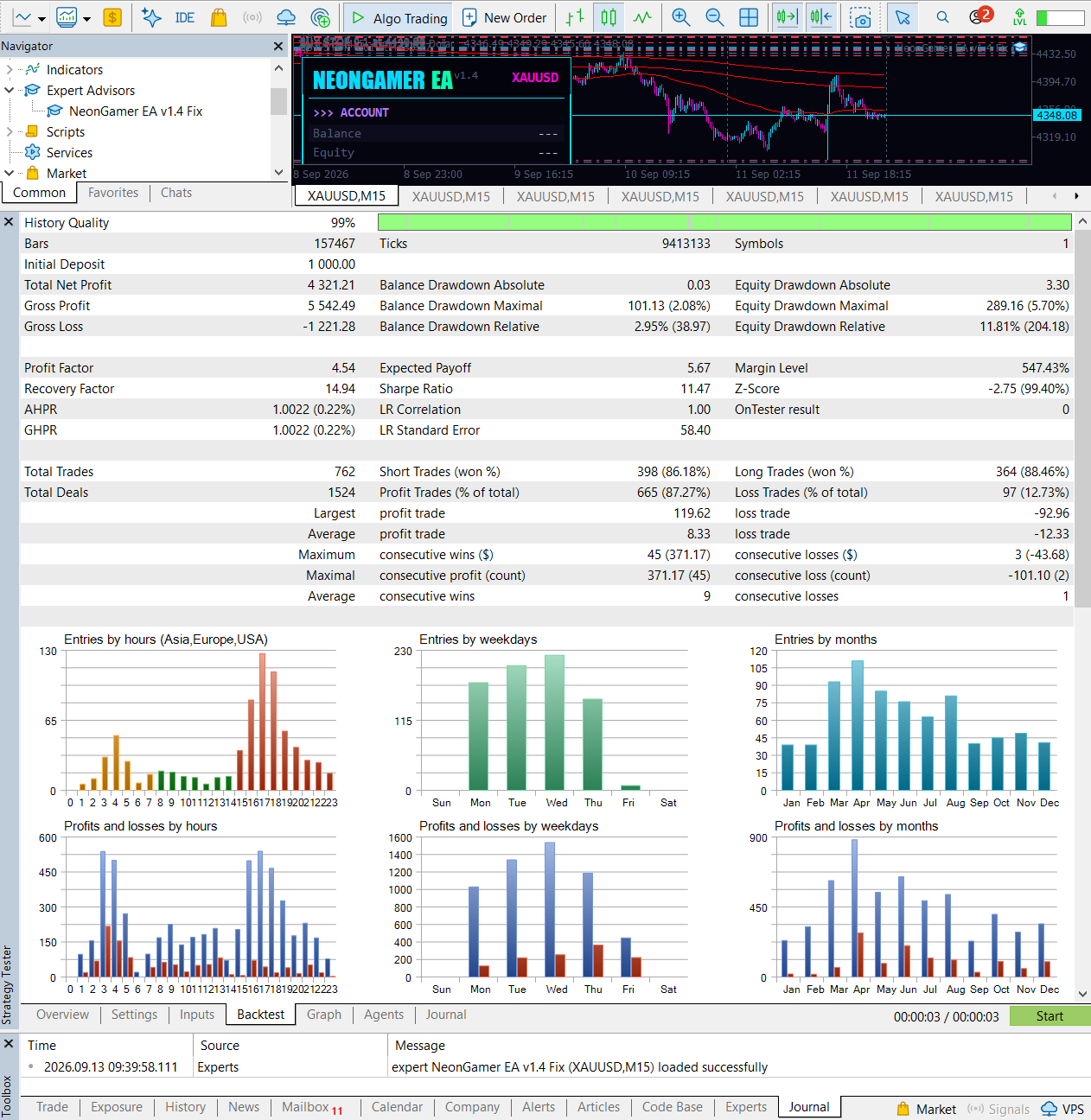
NeonGamer’s six-month report records 267 trades, 16.33% relative equity drawdown and a profit factor of 3.03. Its longer run beginning in 2020 records 762 trades and 11.81% relative equity drawdown, with 99% displayed history quality. A longer report provides more historical conditions, but its lower drawdown does not establish that extending every test reduces risk.
MoonDog’s main report records 236 trades and 17.44% relative equity drawdown. Those similar-looking drawdown percentages do not imply similar loss mechanics. One configuration can accumulate basket exposure while another realizes individual stop losses. The periods, sizing and trading paths differ, and MoonDog’s compounded profit cannot be used to normalize the risk of the two management systems.
Broker and account checks before backtesting
Compare the actual gold symbol, contract size, tick value, minimum lot, lot step, commission and spread. The linked broker comparison concerns its own Quantum Queen observation; it does not establish the best broker for this pair. For eligible FxPro Nano accounts, check the exact currency and symbol specifications before using any preset. Availability and compatibility require confirmation with the broker.
Referral disclosure: TopTradingEAs may receive compensation through the broker links.
Historical equity charts and original tester reports
Read NeonGamer’s six-month and long-test equity curves together with the reports. Look for the depth and duration of floating loss around basket closure. Then inspect MoonDog’s main and validation curves for sequences of individually managed losses. The chart/report pairs show different historical samples, not a standardized grid-versus-breakout experiment.
NeonGamer EA six-month XAUUSD M15 test
NeonGamer EA long XAUUSD test beginning in 2020
MoonDog EA main run


MoonDog EA validation run


Forward-trading screenshots
These monitoring snapshots are separate from the tester runs. Check the visible dates, strategy rows and account activity. Shared-account totals, deposits and other EA trades cannot be attributed to one bot; the images do not establish a continuous independently verified track record.
NeonGamer

View More Forward Trading Results
MoonDog EA

Settings and trade-history checks for this pair
A basket can improve its average entry by adding positions while increasing the amount exposed to a continued move. Those two effects occur together. In the demo log, calculate the volume-weighted entry after each addition and compare it with total lots and available margin. An easier retracement target does not necessarily mean a less demanding account situation.
Separate that observation from the quality of the first signal. EMA, ADX, volume and candle filters can make the start selective, but they do not determine how far price can subsequently trend. Study a rejected setup as well as an accepted one, then inspect what happened after the accepted entry moved against the basket.
MoonDog’s per-trade stop framework creates a different audit trail: realized failed breakouts can appear while other modules remain active. Record both closed and floating losses at the same timestamp. Comparing only completed winning baskets with completed stopped trades would miss the exposure still open in either account.
ATR-spaced grid baskets versus individual breakout trades: what to check in a demo log
For a NeonGamer basket, log every added order, its ATR spacing, volume and contribution to the average entry. Record the largest total lots and floating loss before the group closes. Test the loss-limit action with open positions. These observations answer a more practical question than the win rate: how much exposure can remain while the EA waits for a retracement?
For MoonDog, record initial stop distance, lot size and the other modules already trading. Check the realized loss after a failed breakout and whether a gap affected the fill. Comparing these complete episodes makes the strategy distinction visible. An equal first lot is insufficient when one system can add basket positions, and a Stop Loss still does not guarantee an exact exit price.
Questions about NeonGamer vs MoonDog EA
Does ATR spacing make NeonGamer’s grid risk fixed?
No. Spacing responds to measured volatility, while total risk also depends on volume, order count, market direction, margin and the action taken at the loss limit.
Is MoonDog’s adaptive sizing a recovery grid?
The developer describes ONNX-score adaptive sizing as signal-based and excludes recovery averaging. Verify the actual build and selected mode rather than treating every adaptive option as the same mechanism.
Which NeonGamer loss-limit option matters most?
Check both the threshold and whether it only prevents new entries or also closes active positions. The difference affects floating exposure after the limit is reached.
NeonGamer vs MoonDog EA: practical verdict
Choose this comparison to understand basket management versus individual exits. NeonGamer requires a clear account of how positions accumulate and close together. MoonDog requires a clear account of module overlap and stopped breakout trades. Test the complete exposure path of each configuration; neither a similar drawdown percentage nor a more attractive final balance proves equivalent risk.
Continue the comparison
Compare NeonGamer with Gold Reaper; compare MoonDog EA with Gold Reaper.
Build your own MT5 EA or connect your trading accounts
BYO-Bot is Windows software for building and testing MT5 strategies without coding. Explore cTrader Copier for MT5-to-MT5 and MT5-to-cTrader copying, and check the landing page for current plans and setup requirements.
Trading risk
Automated gold trading can lose capital. Historical backtests and monitoring screenshots do not guarantee future performance. Evaluate the exact build, settings and broker conditions before using a configuration.