

Quantum Queen X vs MoonDog EA MT5: Backtest & Risk Comparison
Quantum Queen X vs MoonDog EA MT5: Backtest and Risk Comparison
Can a configurable grid-style gold EA be meaningfully compared with a multi-strategy breakout robot? We examine original MT5 test reports, trading logic, drawdown, and the limitations of unmatched historical results.

Quantum Queen X vs MoonDog EA: quick comparison
Both Expert Advisors target XAUUSD on MetaTrader 5, but their trade-management approaches differ. Quantum Queen X emphasizes configurable multiple-position and grid-style exposure. MoonDog EA combines five default breakout or price-expansion modules, optional local ONNX filtering and trade-level initial stop-loss/take-profit controls. Its optional MoonLock uses a virtual profit-protection mechanism.
Quantum Queen X
Adjustable trade controls and a multi-position strategy, with floating drawdown risk that deserves close attention.

MoonDog EA
Five default breakout modules, individual SL/TP, and ONNX/MoonLock choices described in the original review.

Grid exposure versus breakout modules: why the strategy matters
Quantum Queen X: managing positions
The existing Quantum Queen X review describes a customizable system with multi-position/grid-style behavior. Exposure may grow as multiple gold trades remain open. Floating equity drawdown and maximum open positions are vital inputs to review.
MoonDog: multiple entry modules
MoonDog uses five initial breakout/price-expansion modules from one chart. The original review describes separate initial SL and TP per trade, optional MoonLock and ONNX filters. Multiple strategies can still create correlated XAUUSD exposure.
MoonDog’s no-martingale/no-recovery-grid behavior is described by its product/review materials; it is not an independent source-code certification. Likewise, grid-style exposure does not determine the outcome of every Queen X setting.
MoonDog Trading Logic and Forward Screenshots
Gold breakout modules include Moon Nova, Apex, Zenith, Pulse and Eclipse. The review describes pending-order entries and individual SL/TP; these snapshots identify v3.34.
These selected snapshots identify MoonDog activity, not a complete audited account record. Other EAs, account-currency differences and incomplete history mean account totals cannot be treated as MoonDog-only returns.


Broker Execution and Smaller-Exposure Nano Testing
Spread, commission, slippage and execution can affect both Quantum Queen X’s multi-position exposure and MoonDog’s breakout modules. In TopTradingEAs’ specific Quantum Queen live comparison, FxPro ranked first and Tickmill second. That observation is not proof of the same ranking for either EA or every account type.
TopTradingEAs uses a cent-denominated FxPro Nano account. Where available for your region and broker entity, it can be considered for restrained live testing after demo setup checks. On a USD-cent account, $10 USD is displayed as 1,000 USC; real capital is still $10. Check gold contract size, tick value, symbol suffix, minimum volume and the EA’s fixed-lot or balance-based sizing before applying presets. Cent denomination alone does not guarantee small risk.
Demo, Nano and standard-account fills can differ. Nano results do not guarantee standard-account outcomes, and no account type removes trading losses. Tickmill is a separate broker alternative; no Nano offering is implied.
Broker links are referral links; TopTradingEAs may receive compensation. Check the applicable entity and current account conditions.
Historical XAUUSD backtest comparison: six-month snapshots
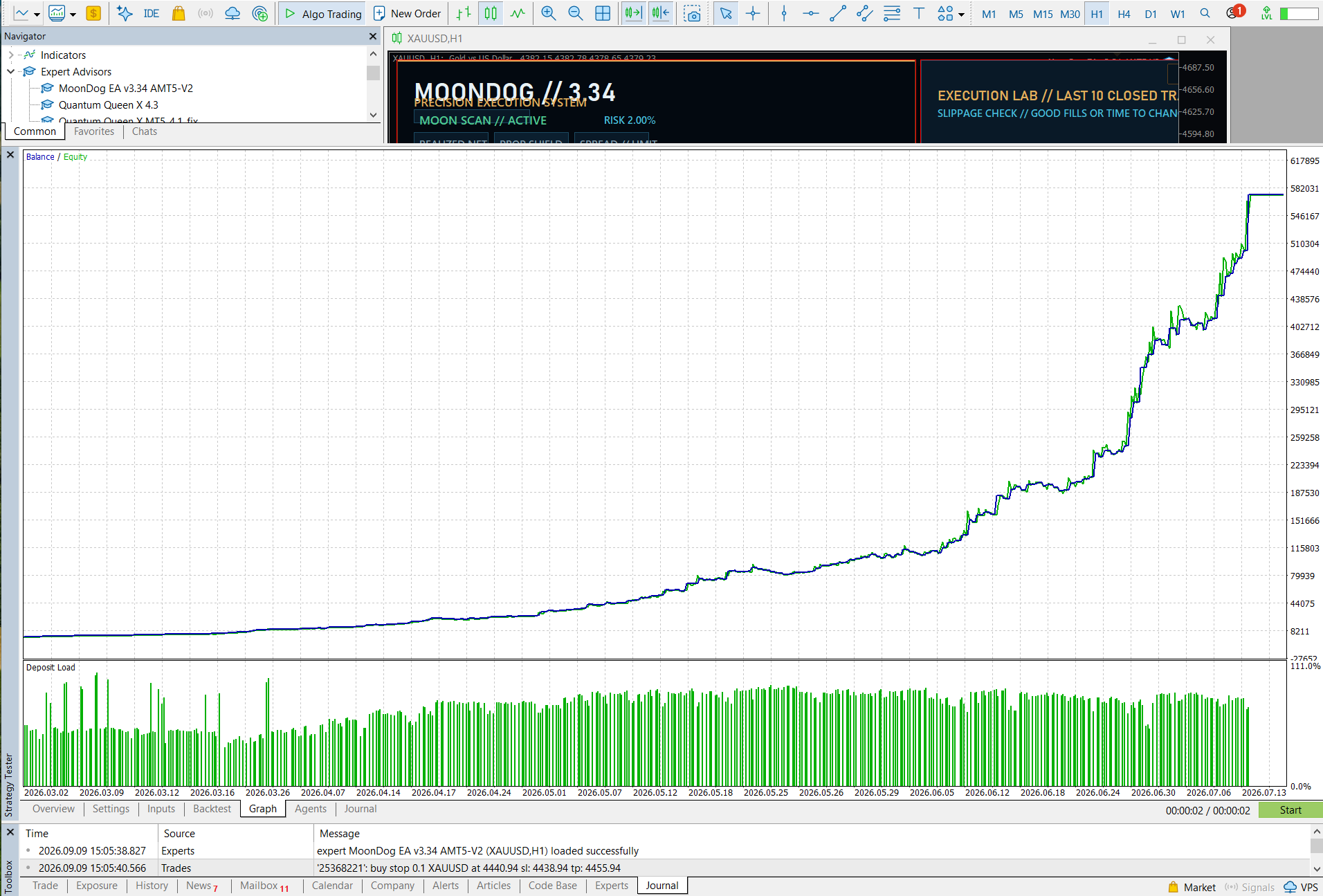
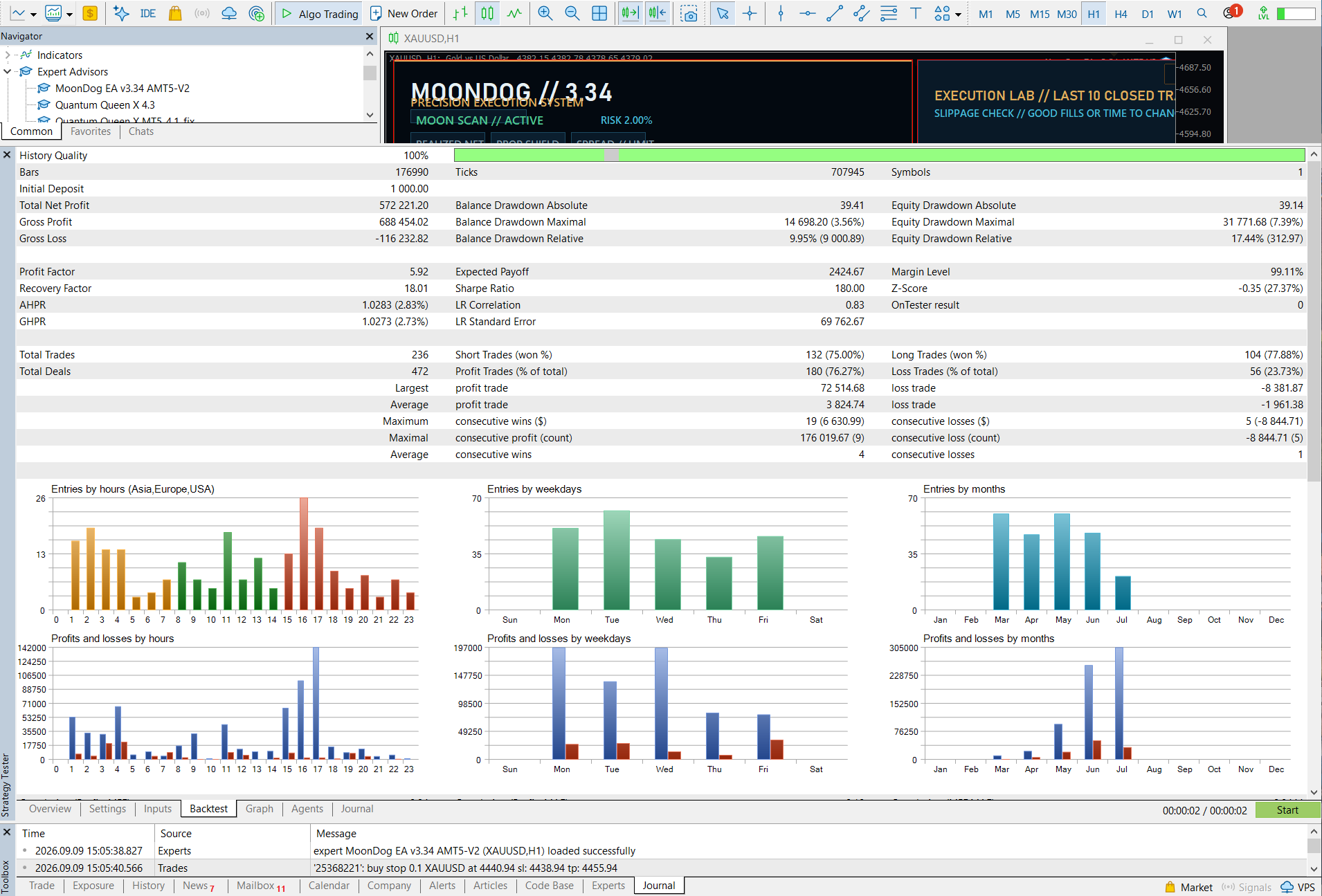
For a consistent narrative we use the six-month results highlighted in each original review. Note that the MoonDog report uses a $1,000 initial deposit with percentage-risk compounding and the original article explicitly warns that compounding magnified reported profits. Do not read its profit figure as a repeatable return.
| Reported metric | Quantum Queen X — Test 2 (six months) | MoonDog EA — six months |
|---|---|---|
| Net profit | $6,726.66 | $572,221.20 |
| Profit factor | 4.44 | 5.92 |
| Recovery factor | 3.59 | 18.01 |
| Profitable trades | 80.00% | 76.27% |
| Total trades | 365 | 236 |
| Drawdown as labeled in original review | 43.50% (review labels “Drawdown”) | 17.44% relative equity DD |
MoonDog’s profit factor and recovery factor are higher in these particular tester screenshots, while Quantum Queen X shows a higher win rate and more trades. The different drawdown labels, starting conditions and MoonDog’s compounding mean none of these numbers proves one EA is superior live.


Shorter tests offer a different risk perspective
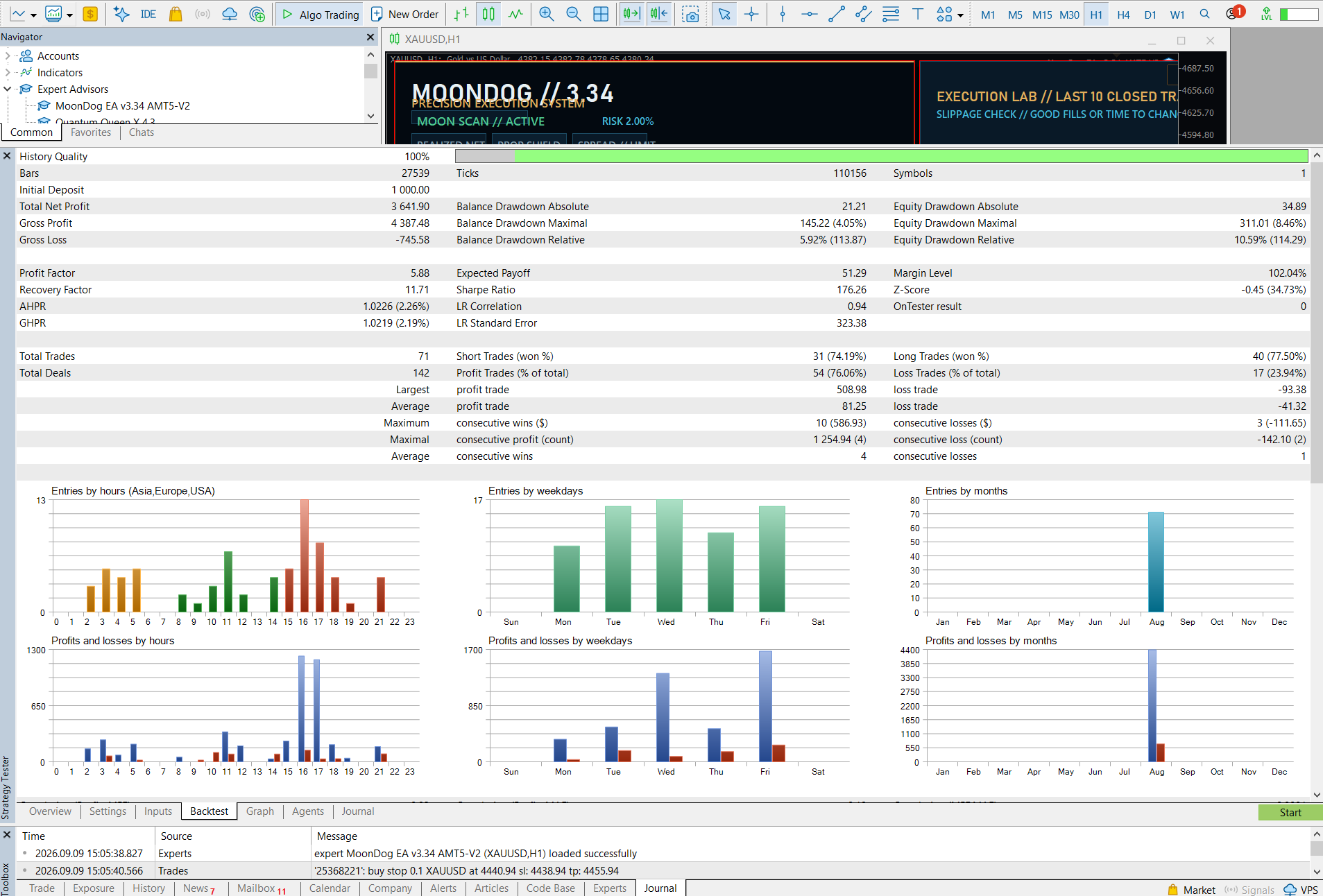
The original Quantum Queen X review includes a short test: net profit $242.67, profit factor 9.56, drawdown 5.16%, win rate 90.24%, across only 41 trades. MoonDog’s shorter report shows $3,641.90 net profit, profit factor 5.88, relative equity drawdown 10.59%, a 76.06% win rate and 71 trades. Short tests are less informative about changing markets, but they underline how sensitive headline statistics are to sample period and exposure.

MoonDog risk controls versus Queen X trade controls
MoonDog controls to examine
Review its chosen five-module preset, fixed-lot or percentage-risk sizing, individual SL/TP, optional MoonLock settings, ONNX selection and news/weekend protections. Virtual exits can be affected by market execution or platform connectivity.
Queen X controls to examine
Check maximum trades, lot progression, custom strategy options and total basket exposure. Account-level risk can be substantially different from an individual position’s risk.
Neither robot can eliminate gold-market gaps, execution delays, spread widening or broker differences. Assess the current version’s actual inputs before moving beyond demo testing.
Watch the original expert advisor review videos
Quantum Queen X
MoonDog EA
Which MT5 gold EA should you investigate?
Investigate Quantum Queen X if you want to understand the flexibility and the risks of multi-position trade management. Investigate MoonDog EA if you prefer to evaluate multiple breakout signals with individually initialized stop-loss/take-profit management and optional entry filters. Neither characterization is a personalized investment recommendation.
Frequently asked questions
Is MoonDog EA better than Quantum Queen X?
The published tester runs are not controlled comparisons. MoonDog shows higher profit factor in one six-month snapshot, but its compounded profit and risk model differ; this does not establish live superiority.
Does Quantum Queen X use grid trading?
The original Quantum Queen X review describes grid-style multi-position exposure. Check current product settings to understand actual position and floating-loss behavior.
Does MoonDog use martingale or a recovery grid?
The original product/review descriptions say it does not. This comparison relies on those descriptions rather than independent source-code verification.
Are MoonDog’s reported six-month profits repeatable?
No. The original review notes that percentage-risk compounding greatly magnified its historical results. Trading conditions and risk exposure vary.
Should I compare balance or equity drawdown?
Both matter, but equity drawdown includes unrealized floating profit/loss and is particularly important for multi-position systems. Only compare values with matching labels and test conditions.
Build MT5 EAs or copy trades between accounts
BYO-Bot is Windows software for building and testing MT5 strategies without coding. Free Edition exports eligible Single Position strategies using standard exits with Loss Recovery off. Premium exports require an active monthly licence. cTrader Copier copies MT5 to MT5 free, or MT5 to cTrader with a paid subscription. Neither tool guarantees a strategy’s trading results.
Final verdict: compare risk architecture, not just net profit
Quantum Queen X vs MoonDog EA highlights a meaningful difference between grid-style multi-position management and a multi-module breakout approach. Existing historical results offer useful questions about trade count, profit factor, risk sizing and drawdown. They do not identify a guaranteed winner. Read the complete reports and test on the broker, platform version and risk settings you actually plan to use.


