


MoonDog EA vs Wave Rider EA MT5: Strategy & Backtest
MoonDog EA vs Wave Rider EA MT5: Breakout vs Hybrid Scalping
Comparing two very different XAUUSD robots: MoonDog’s modular breakout strategy and Wave Rider’s seven-strategy hybrid scalping framework. We examine their historical MetaTrader 5 charts, trade counts, profit factors, drawdown and risk settings—not just headline profit.
Watch the Original MoonDog & Wave Rider Reviews
Both embedded videos are the original individual reviews. They are sources for this comparison, not footage of a controlled head-to-head test.
MoonDog EA MT5 Original Review
Wave Rider EA MT5 Original Review
MoonDog EA vs Wave Rider EA: Which Trading Logic Suits Your Research?
Both EAs trade gold on MetaTrader 5, but their architecture differs. MoonDog is a multi-strategy breakout EA, offering five default strategies and optional additional modules. Its product documentation describes an initial stop-loss and take-profit attached to each position, optional MoonLock profit locking and a locally run ONNX filter. Wave Rider combines seven strategy engines with multi-timeframe market analysis and lets users choose between Recovery Grid and Single Position management. Their tester screenshots come from different configurations and risk models.
MoonDog EA
Five default breakout strategies plus optional modules, individual trade exits, optional ONNX filtering and MoonLock. Simultaneous signals can still increase combined exposure.
Wave Rider EA
Seven hybrid strategy engines, higher-timeframe directional context, lower-timeframe signals, and Recovery Grid or Single Position modes with different risk mechanics.
MoonDog EA Trading Logic: Breakout Modules, ONNX and MoonLock
MoonDog’s original five modules are Moon Nova, Moon Apex, Moon Zenith, Moon Pulse and Moon Eclipse. The developer also describes optional Moon Orbit, Moon Halo, Moon Titan and Moon Comet strategies. A trader can operate multiple strategies from one chart; this increases diversification of entry logic but not necessarily diversification of market risk, because the underlying market remains XAUUSD.
Each recognized position has its own initial SL and TP. Product materials describe default initial stop loss of 20 gold pips and take-profit targets around 140–150 gold pips, with configurable settings. The MoonLock feature tracks eligible floating profits and seeks to protect a proportion of peak gains after activation. It is a virtual close rule, not a guaranteed stop fill. Adaptive MoonLock changes activation and protection profiles by strategy rather than retraining the EA.
ONNX options include a conservative local filter, a more-trades filter and operation without ONNX. Running locally avoids reliance on an external prediction API, but the neural filter does not guarantee profitable predictions. News, spread and weekend protections may suspend new entries or manage pending orders rather than forcibly close existing positions. Continuous execution and a VPS can matter for virtual protections.
The vendor says MoonDog uses neither a recovery grid nor martingale. Treat this as product documentation, not an independent audit. Multiple concurrent modules still require an account-wide exposure assessment.
MoonDog Trading Logic and Forward Screenshots
Gold breakout modules include Moon Nova, Apex, Zenith, Pulse and Eclipse. The review describes pending-order entries and individual SL/TP; these snapshots identify v3.34.
These are selected attributable snapshots, not a complete independently audited account record. Other EAs, deposits, withdrawals, open positions and account-currency differences can affect displayed totals. Do not interpret shared-account totals as this EA’s standalone returns.


Wave Rider EA Trading Logic: Seven Strategies and Two Trade Modes
Wave Rider is presented as an XAUUSD hybrid scalper with seven engines that combine different market-opportunity types. Its review describes H1 as a higher-level analysis context, while M5, M15 and M30 provide confirmation and execution context. Exact proprietary signal equations are not disclosed in the article; it would be misleading to invent indicator conditions.
Its management mode is central to the comparison. In Single Position mode, exposure is generally concentrated in an individual position and its exits. Recovery Grid mode can add further positions and manage aggregate exits. A grid can realize frequent recoveries in range-bound conditions yet accumulate significant floating drawdown during an extended move against the basket. The review also describes multiple layers of protection, but a protection setting cannot eliminate sudden spread widening or guarantee an exact maximum live loss.
When evaluating Wave Rider, record the chosen trade mode, fixed or auto lot settings, max positions, recovery spacing, basket exit logic, maximum exposure and whether all seven modules are active. A six-month historical tester run with fixed 0.01 lots is not equivalent to a different account running compounding risk or Recovery Grid with a larger maximum basket size.
Wave Rider Trading Logic and Forward Screenshots
Seven described gold entry engines combine H1 context with lower-timeframe confirmation. Recovery Grid and Single Position are alternative management models with different exposure.
These are selected attributable snapshots, not a complete independently audited account record. Other EAs, deposits, withdrawals, open positions and account-currency differences can affect displayed totals. Do not interpret shared-account totals as this EA’s standalone returns.

Broker Execution and Smaller-Exposure Nano Testing
Spread, commission, slippage and execution can affect MoonDog and Wave Rider. In TopTradingEAs’ specific Quantum Queen live comparison, FxPro ranked first and Tickmill second. That observation is not proof of the same ranking for either EA or every account type.
TopTradingEAs uses a cent-denominated FxPro Nano account. Where available for your region and broker entity, it can be considered for restrained live testing after demo setup checks. On a USD-cent account, $10 USD is displayed as 1,000 USC; real capital is still $10. Check gold contract size, tick value, symbol suffix, minimum volume and the EA’s fixed-lot or balance-based sizing before applying presets. Cent denomination alone does not guarantee small risk.
Demo, Nano and standard-account fills can differ. Nano results do not guarantee standard-account outcomes, and no account type removes trading losses. Tickmill is a separate broker alternative; no Nano offering is implied.
Broker links are referral links; TopTradingEAs may receive compensation. Check the applicable entity and current account conditions.
MoonDog EA vs Wave Rider: Historical MT5 Backtest Summary
The available source reports are historical Strategy Tester snapshots, not synchronized controlled tests. MoonDog’s short and main six-month tests involve different initial deposits and trade sizing from Wave Rider’s fixed-lot tester snapshots. Comparing raw net profit to decide a winner would therefore be inappropriate.
| Original test | Net profit | Profit factor | Equity drawdown | Trades |
|---|---|---|---|---|
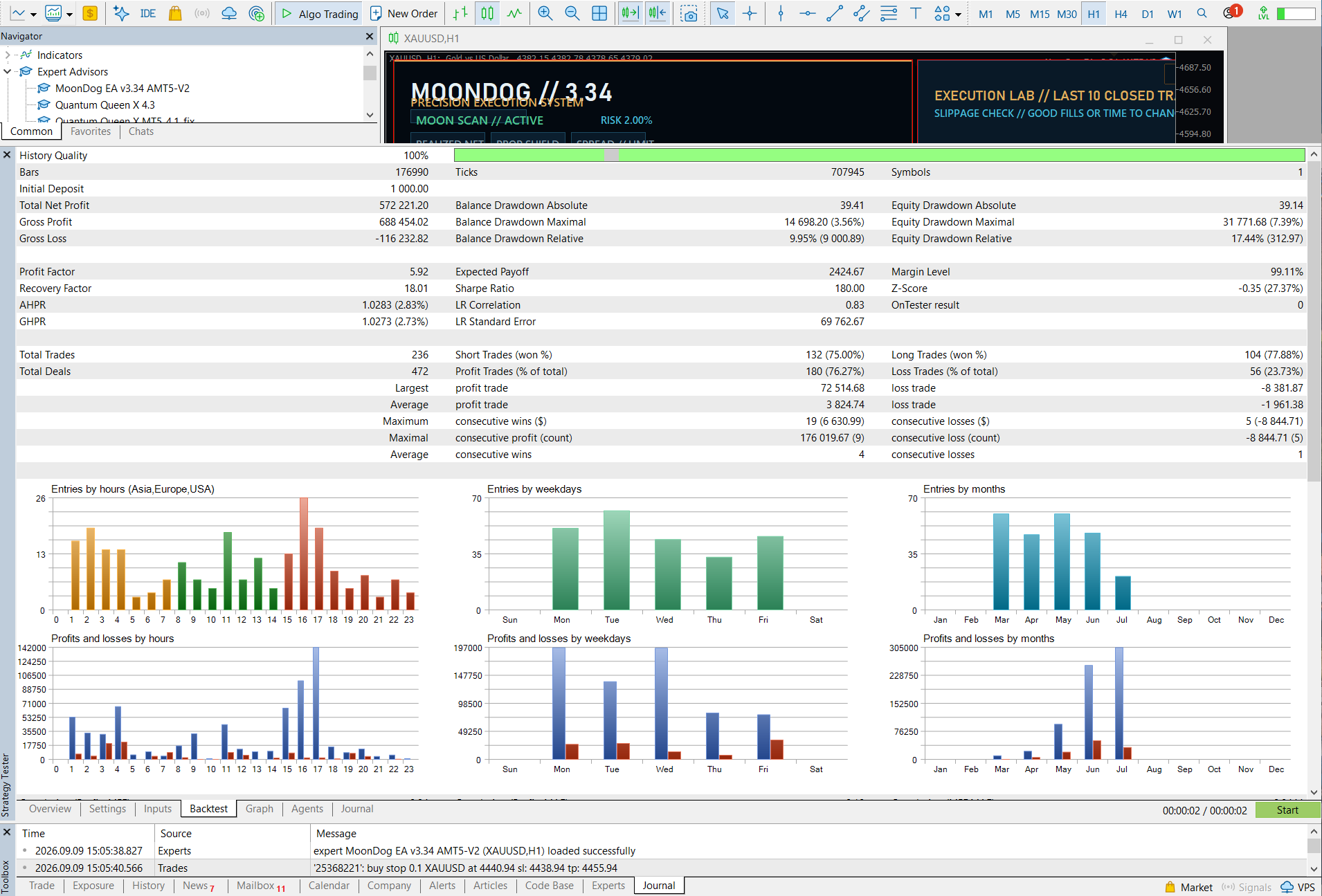
| MoonDog main six-month | $572,221.20 | 5.92 | 17.44% relative | 236 |
| MoonDog shorter test | $3,641.90 | 5.88 | 10.59% relative | 71 |
| Wave Rider six-month | $884.43 | 5.04 | 15.13% relative | 253 |
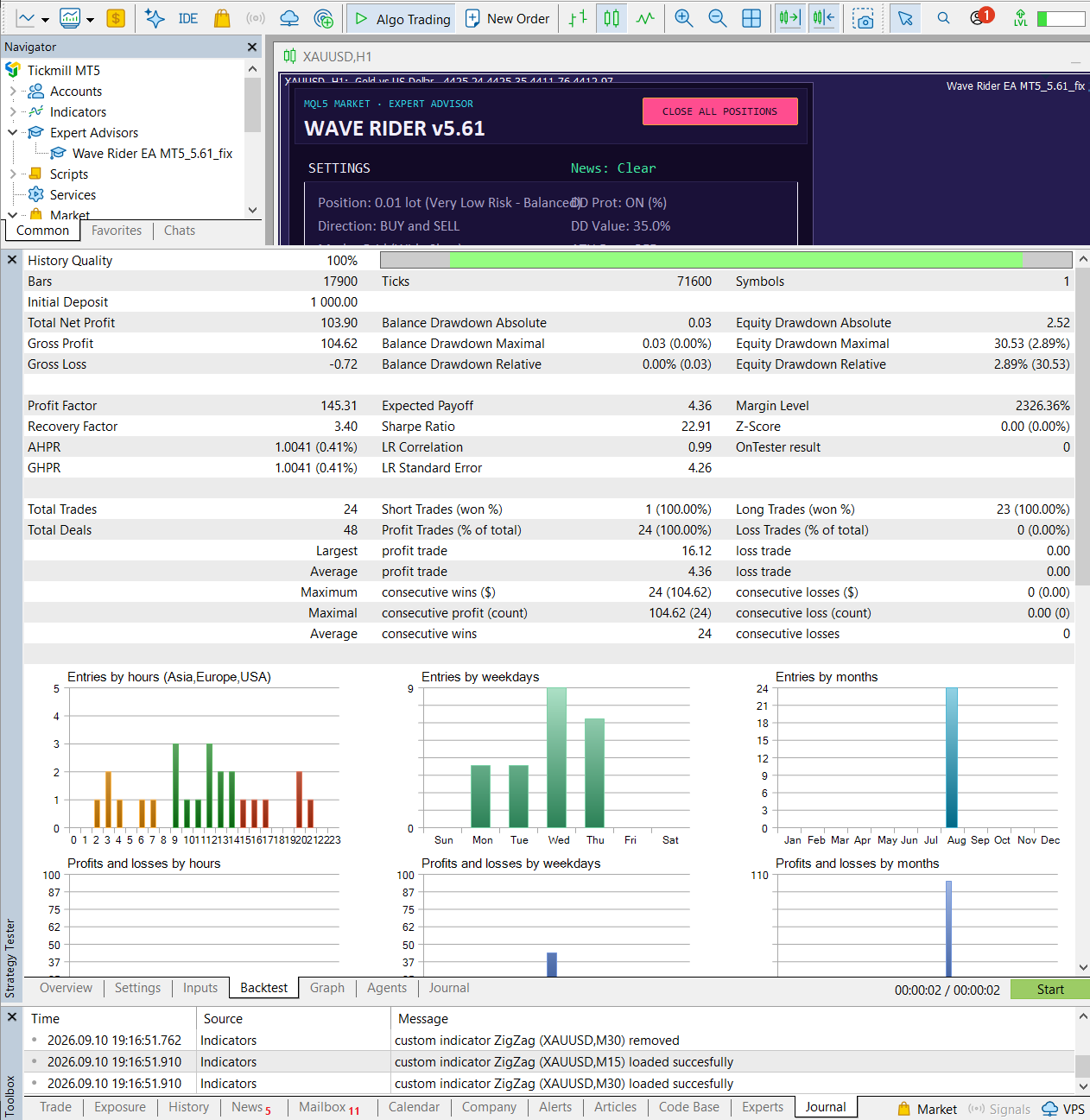
| Wave Rider one-month | $103.90 | 145.31 | 2.89% relative | 24 |
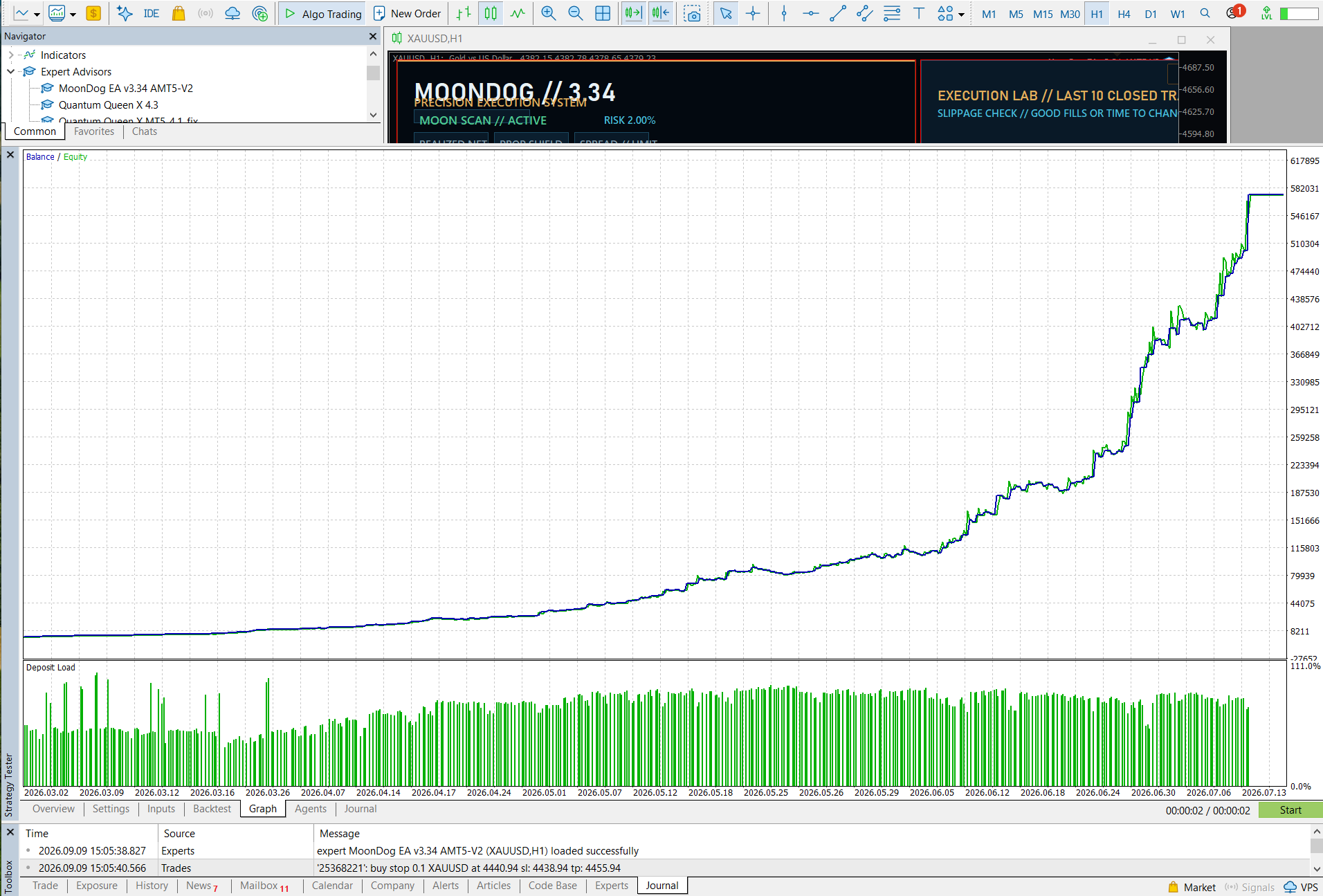
MoonDog six-month equity curve and tester report
The main MoonDog tester run reported a strong historical profit factor and 236 positions. The relative equity drawdown is more informative for risk screening than the very large compounded ending profit.
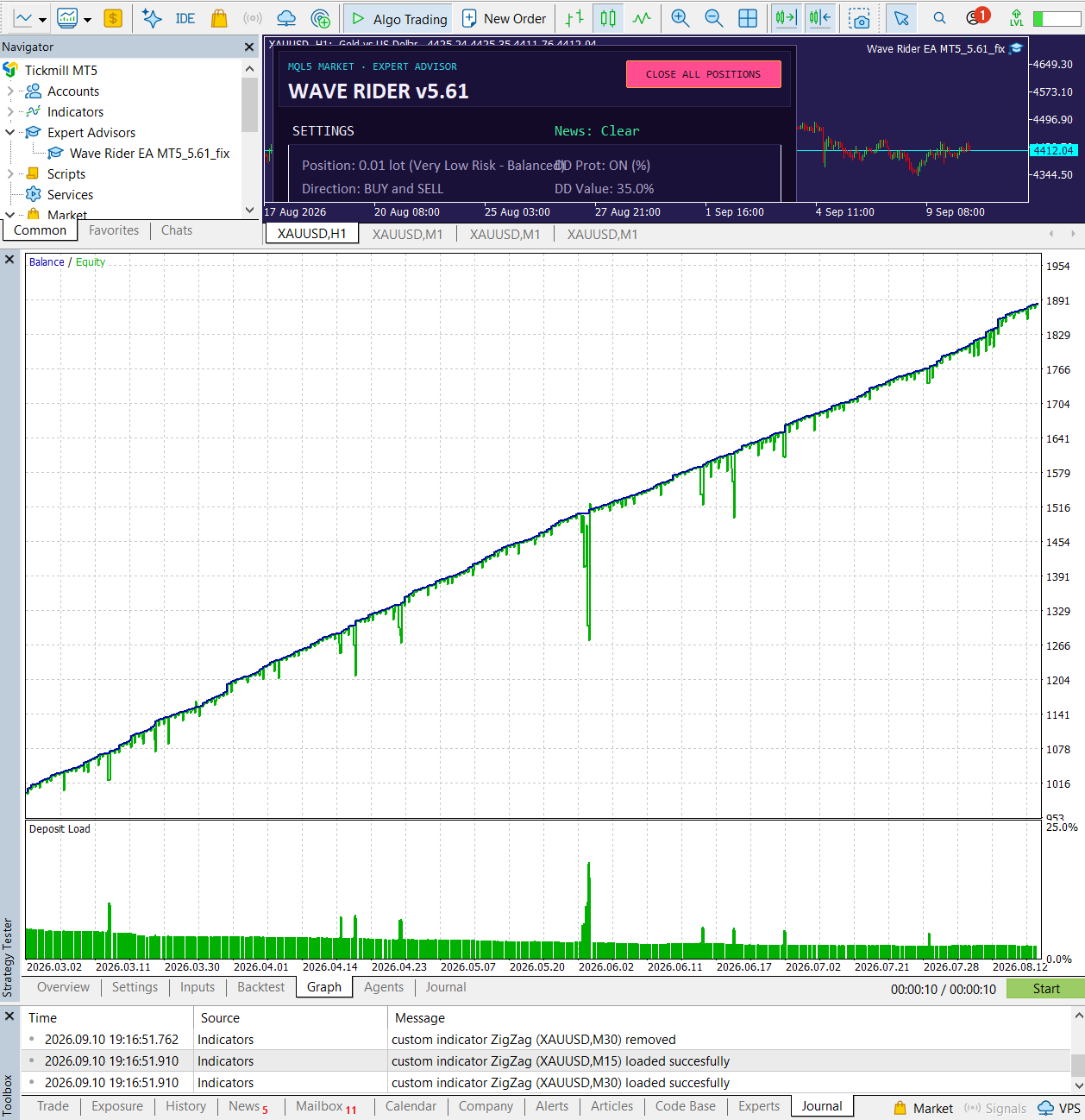
Wave Rider six-month equity curve and report
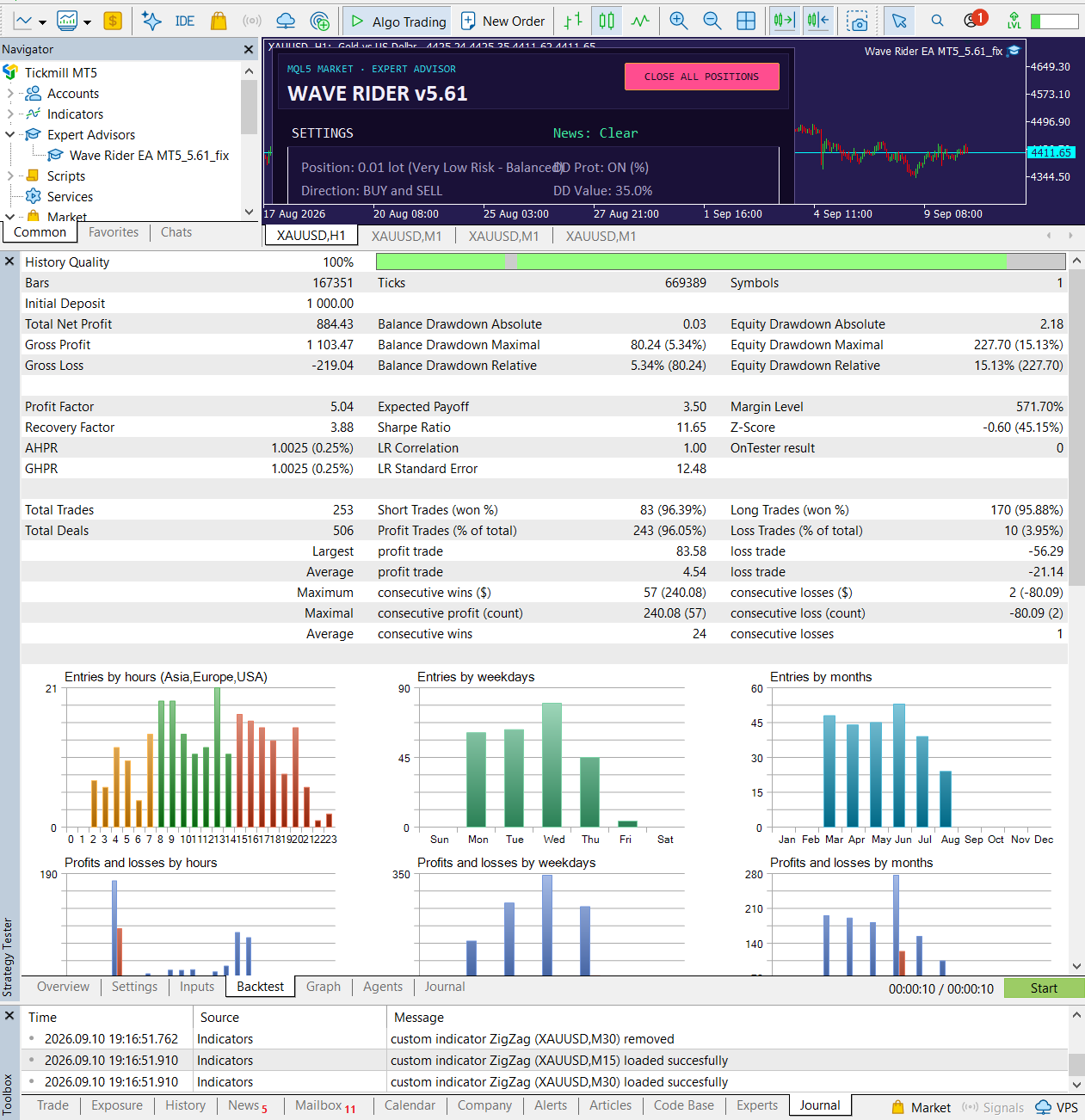
Wave Rider’s six-month run reported $884.43 net profit, profit factor 5.04, 253 trades and 15.13% relative equity drawdown. Its underlying $1,000 deposit and fixed 0.01-lot assumptions differ materially from other backtest models.
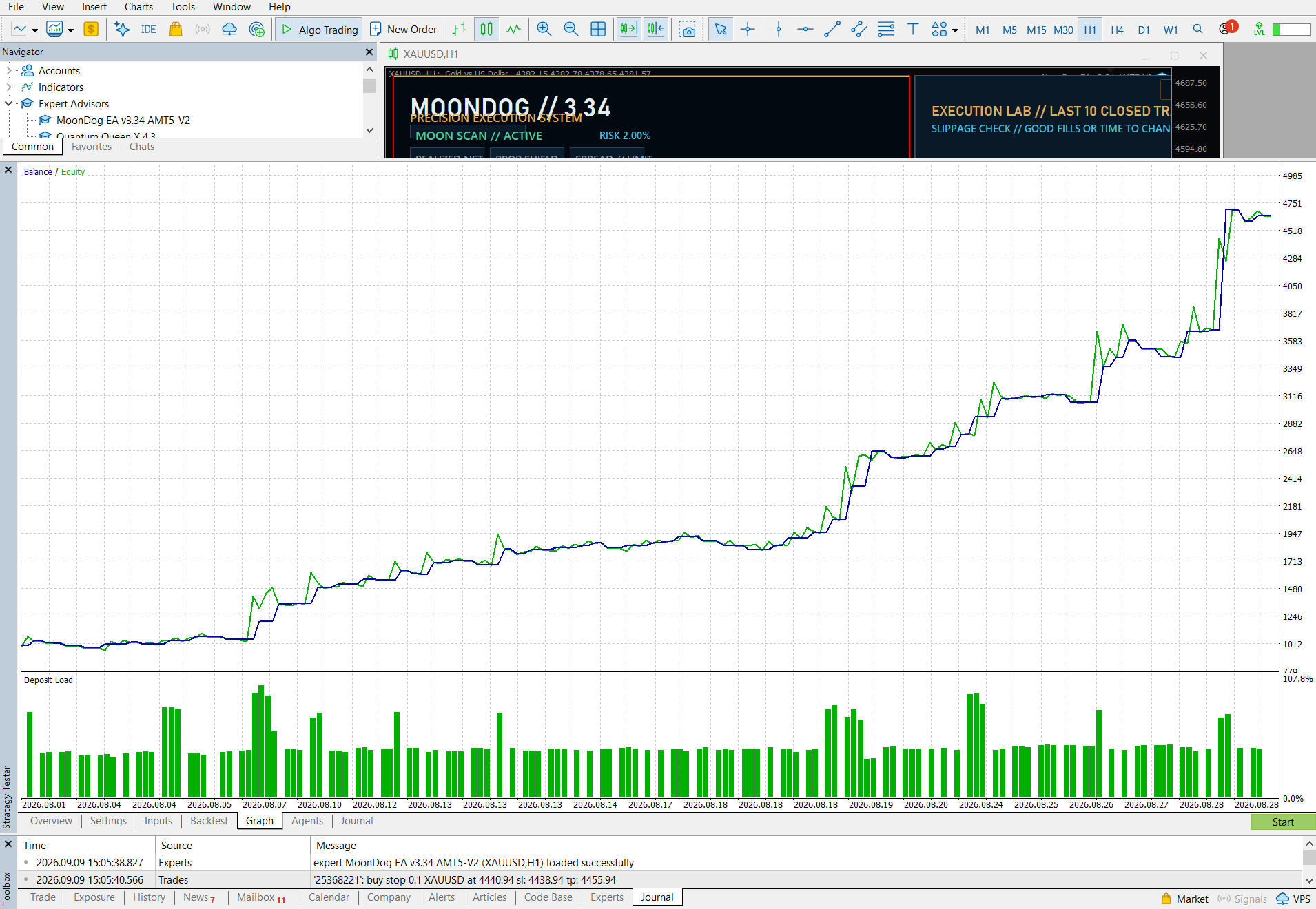
MoonDog shorter-run chart and report
The shorter MoonDog result was generated from a smaller 71-trade sample. A smaller sample may omit difficult market regimes and rare loss clusters.
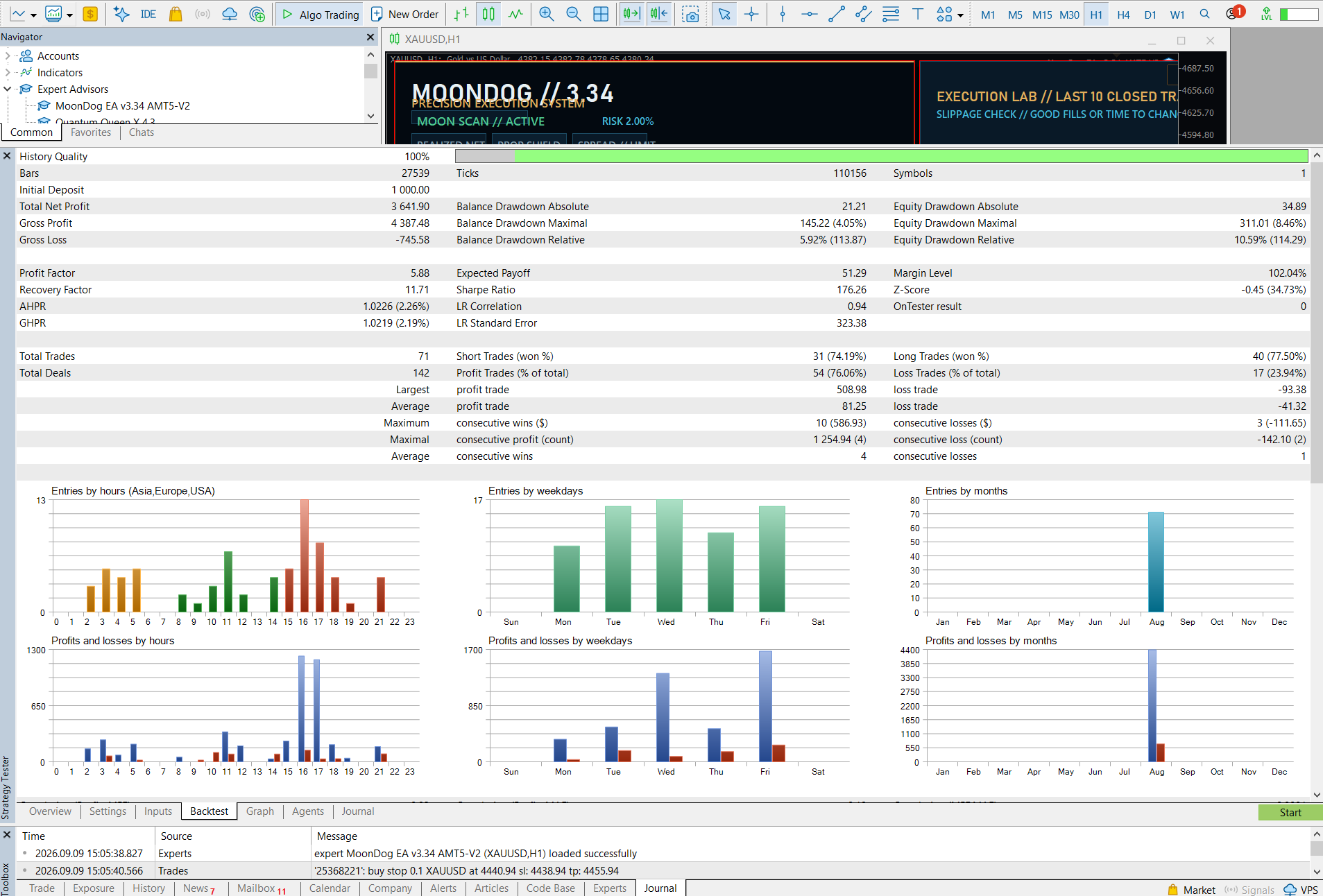
Wave Rider one-month chart and report
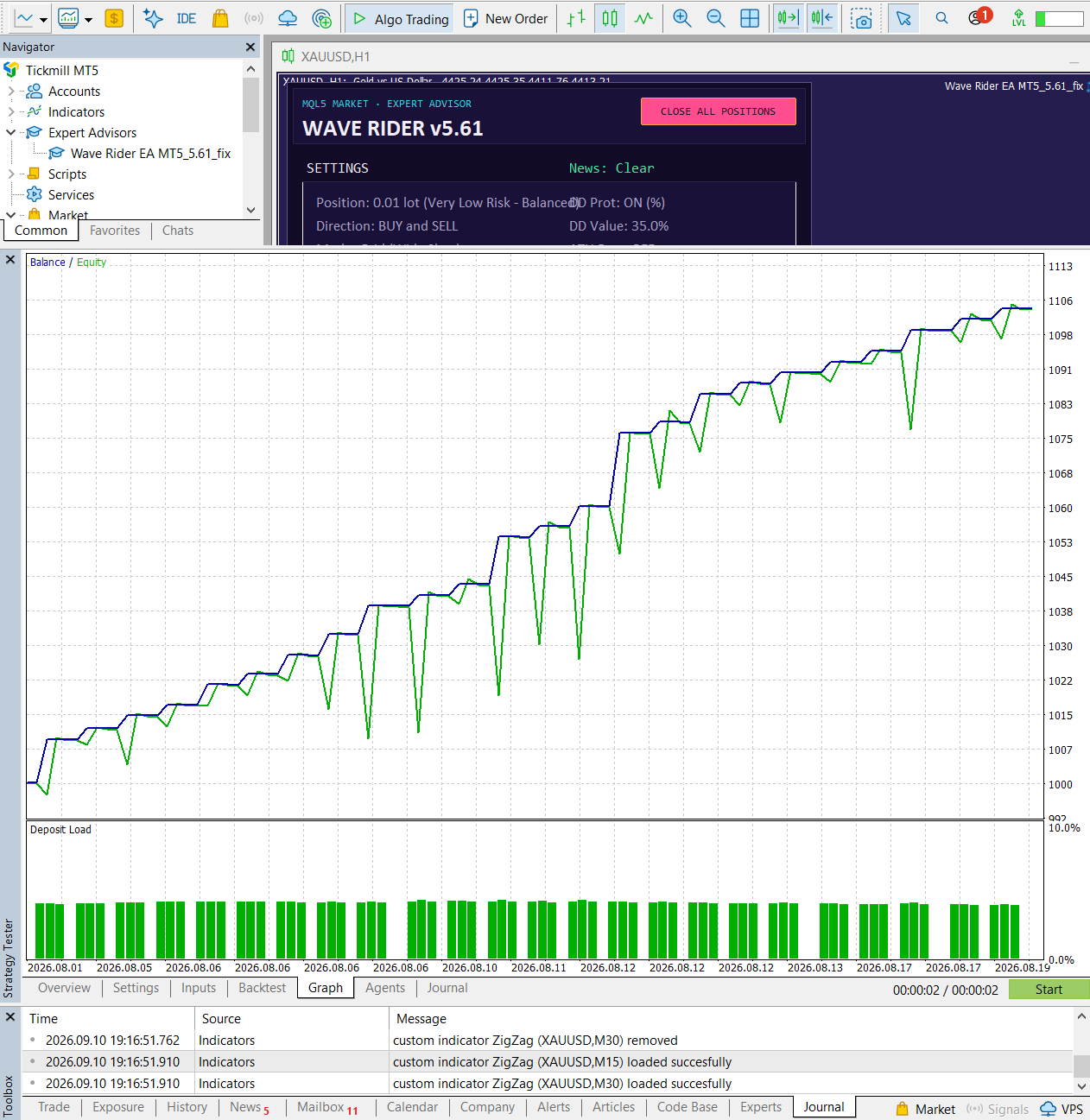
Wave Rider’s short one-month test reports unusually high profit factor on 24 trades. Very low observed losses make such ratios statistically unstable; check the six-month sample before making conclusions.
Risk Comparison: Individual Stops vs Recovery-Grid Exposure
MoonDog’s documented initial stop and target per trade offer a different risk structure from a Wave Rider basket in Recovery Grid mode. MoonDog may open several strategies concurrently, so trade-level stops do not imply a strict portfolio drawdown ceiling. Wave Rider in grid mode may increase exposure after initial entries; open basket equity can deteriorate long before positions close. Switching Wave Rider to Single Position changes this risk profile fundamentally and should be tested independently.
Which MT5 Gold EA Should You Investigate?
Investigate MoonDog if you want several separately managed breakout modules, optional ONNX filters and configurable MoonLock protection. Scrutinize simultaneous signal risk and reliance on virtual stop-management execution. Investigate Wave Rider if you want to compare a seven-engine hybrid scalper under two fundamentally different trade-management systems. Scrutinize Recovery Grid maximum basket size, margin, spacing and the possibility of persistent directional gold moves.
The historical results do not justify calling either robot universally better. Independent matched-risk forward observation would offer stronger evidence than visually comparing two originally unrelated tester reports.
Build your own EA or copy trades between accounts
Want to create your own MT5 trading strategy? Explore BYO-Bot, the Windows software for building MT5 EAs without coding. With cTrader Copier, copy trades from MT5 to another MT5 account for free, or from MT5 to cTrader with a paid subscription.
Frequently Asked Questions: MoonDog vs Wave Rider EA
Is MoonDog EA better than Wave Rider on XAUUSD?
No controlled head-to-head result is provided. The source tests differ in trading modes, position sizing and other conditions.
Does MoonDog use martingale or grid recovery?
The product documentation describes it as using neither, although this comparison is not an independent source-code audit.
Can Wave Rider operate without Recovery Grid?
Its source review describes a Single Position option. Verify the actual active preset and tester report for the mode you intend to use.
Why is Wave Rider’s one-month profit factor 145.31?
Only 24 trades were recorded with very low gross historical losses. A small loss denominator makes profit factor particularly sensitive to future losing trades.
Do MoonDog’s trade-level stop losses guarantee a low total account drawdown?
No. Gold market gaps, slippage and simultaneous strategy positions can still create material combined exposure.
Explore MoonDog EA, Wave Rider & More MT5 Robots
Check original reports, settings, broker execution and risk limits before considering live trading.