


Gold House vs Nexorion EA MT5: Stops & Floating Risk
Gold House vs Nexorion Initium Novum EA MT5: Two No-Grid Descriptions, Different Equity Paths
Compare Gold House swing breakouts with Nexorion’s H1 liquidity framework. Five genuine tester pairs, source videos and attributable forward screenshots help distinguish stop descriptions, closed-trade results and floating equity exposure.

Watch Both Original EA Reviews
The original videos explain the reviewed versions and source test records. They are separate demonstrations, not an equal-risk head-to-head experiment. Follow the configuration labels in each report rather than treating the product name as one unchanging strategy.
Gold House original review
Nexorion Initium Novum EA original review
Two No-Grid Descriptions, Different Equity Paths
Gold House
Five swing-breakout modules, adaptive stops, partial exits and three management priorities.
745 trades; 36.46% relative equity drawdown in the January–June 2026 report.
Nexorion Initium Novum EA
H1 liquidity-and-equilibrium analysis with source-described deterministic stop protection.
146 profitable closures alongside 59.34% relative equity drawdown in January–June 2026.
What This Gold House vs Nexorion Initium Novum EA Comparison Examines
This Gold House vs Nexorion Initium Novum EA MT5 comparison focuses on two no-grid descriptions, different equity paths. It reuses the Gold House source review and Nexorion Initium Novum EA source review, with original chart/report pairs and attributable forward snapshots. Product descriptions are source claims, not independent audits of proprietary code.
The reports use their own dates, settings and sizing. Common initial deposits do not standardize exposure, leverage or execution costs. Historical account growth is not an expected live return, and an attractive profit factor is not a verified maximum loss.
How Gold House Trades: Swing Breakouts and Adaptive Exits
Gold House v3.0 is described as an XAUUSD swing-breakout system using five strategy modules. Rather than adding recovery-grid layers, it seeks moves through swing highs or lows with trend filtering and protected entries. The source description states no grid, no martingale and a mandatory Stop Loss on each trade.
Its adaptive distance logic is intended to scale Stop Loss, Take Profit and trailing parameters as the gold price environment changes. This concerns exit distances; it does not establish that the account’s percentage risk stays constant. Lot sizing and the number of simultaneous entries still matter.
Three management priorities
Adaptive, Profit Priority and Break-even Priority modes are described. Their names indicate different management choices, not guaranteed outcomes or a universal best preset.
Partial closes and trailing
Partial exits may realize part of a move while leaving remaining volume exposed. Trailing or break-even changes can protect some gains, but spread and slippage affect the actual exit.
Gold House Forward-Trading Snapshot
The Gold House screenshot contains strategy-labelled history such as PendingA, PendingB, PendingC, PendingD and PendingE, with both positive and negative results. Those comments support attribution of the visible rows. They do not reveal the full equity path, prove the account’s authenticity or establish independently verified live performance.

Nexorion Strategy: Liquidity, Equilibrium and Deterministic Entries
Nexorion’s reviewed design targets XAUUSD/gold on H1. The description combines buy-side and sell-side liquidity tracking, equilibrium calculations, premium/discount classification and mathematical trade validation. Vector-phase resonance is another named component, but the public source does not provide enough detail to reconstruct its equations.
Visual chart mapping shows the algorithm’s selected structures. It may help explain what the system is monitoring, but it does not independently establish an institutional edge or future predictive accuracy.
Source-described protection
The review states that each position receives deterministic Stop Loss protection and excludes grid expansion, averaging and martingale. Confirm that description against the installed version and preset rather than assuming every build behaves identically.
Observed equity behaviour
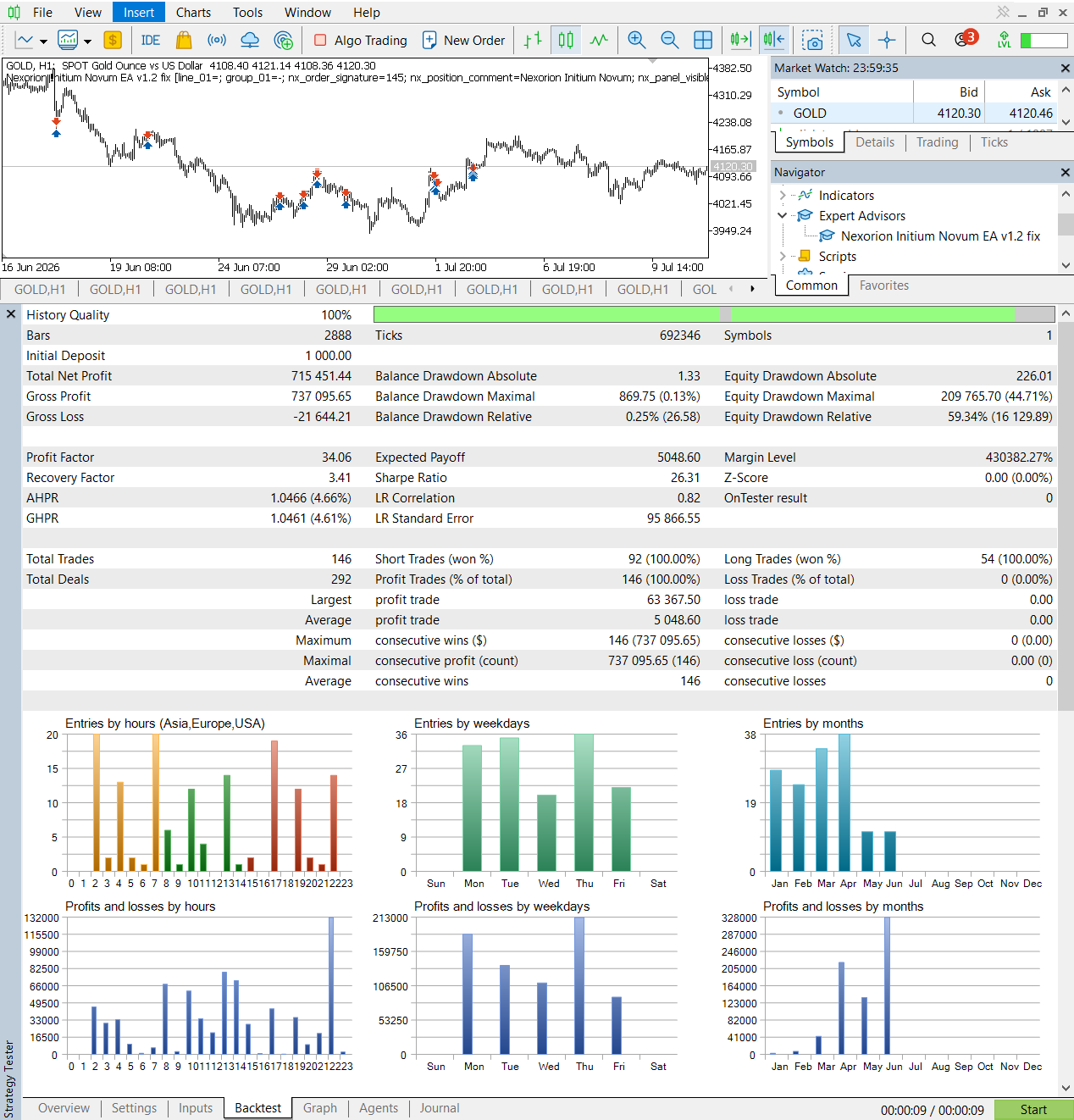
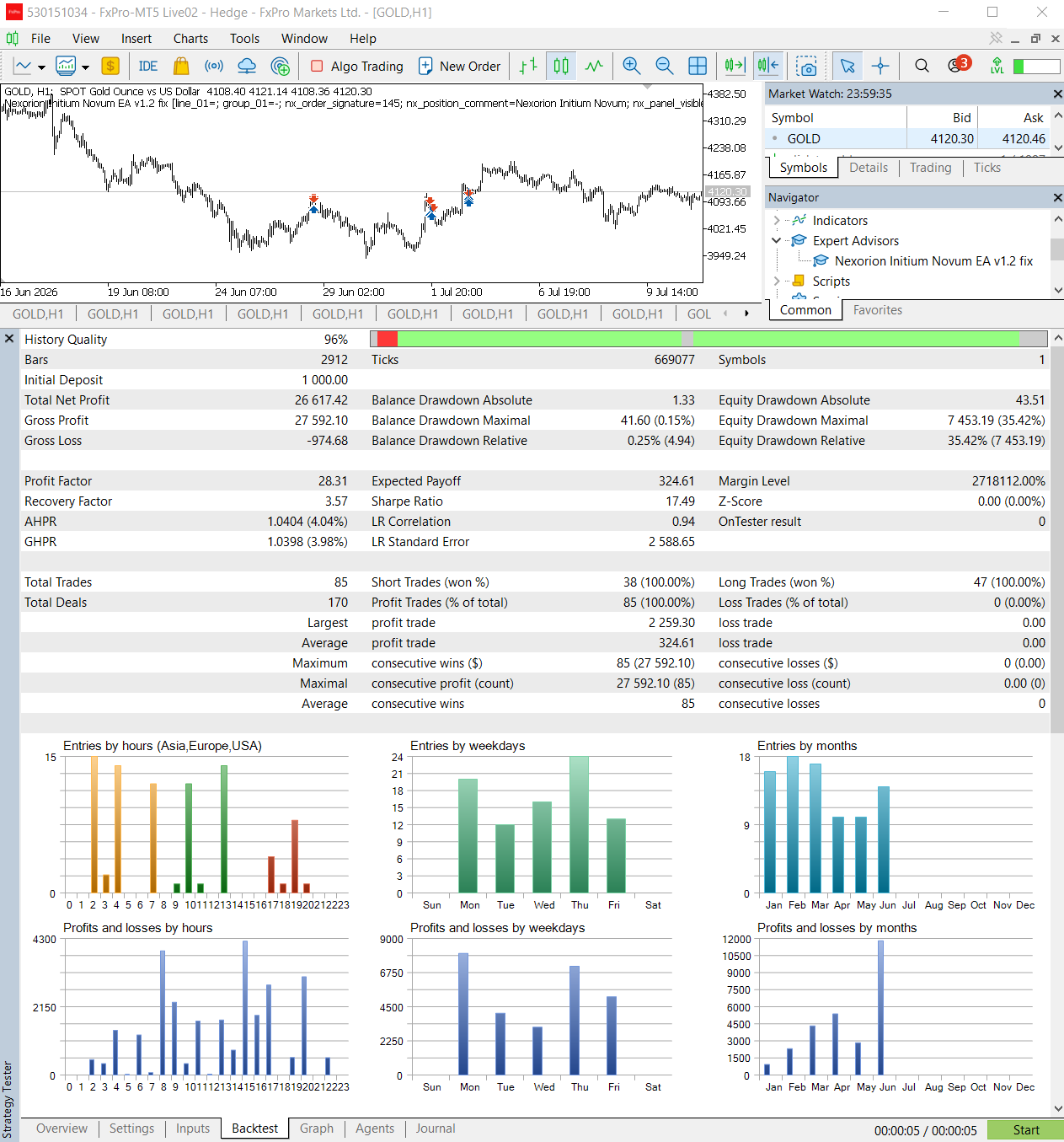
All completed trades in the three reports are profitable, while relative equity drawdown reaches 35.42%, 44.95% and 59.34%. Profitable closure and low floating risk are different properties.
Those reports do not establish why every closure was positive, exactly how stops evolve or the full sizing rules. Investigate exposure duration, changing lot sizes and the response when liquidity analysis fails. Defined stops remain subject to gaps, slippage, order rejection and platform conditions.
For a no-grid gold EA comparison, the distinction is practical: excluding recovery layers removes one source of expanding exposure, but position size, stop distance and holding behaviour can still create substantial account fluctuations.
Nexorion Forward-Trading Snapshot
The uploaded snapshot contains Nexorion-labelled history rows alongside other EAs. Only those labelled rows can be attributed to Nexorion; the account balance, equity and other dashboard totals are not Nexorion-only performance. Account type, completeness and independent verification are not established.

Recommended Brokers and Smaller-Exposure Nano Testing
Spread, commission, slippage and execution can materially affect active gold strategies. In TopTradingEAs’ specific Quantum Queen live comparison, FxPro ranked first and Tickmill second. That experience makes them candidates to investigate, not proof of the same ranking for Gold House or Nexorion Initium Novum EA.
For initial small-exposure live testing, consider an eligible FxPro Nano account. TopTradingEAs uses this cent-denominated account; the FxPro account email describes cent-sized exposure and real execution. For a USD-cent balance, $10 USD appears as 1,000 USC—it is still $10 of capital. Confirm regional availability, gold contract size, minimum volume and the EA’s sizing behaviour before using presets. A numeric 1,000 USC balance is not equivalent to a $1,000 standard-account risk budget.
Demo testing remains useful for setup checks, but its fills can differ from live execution. Nano results also do not guarantee standard-account outcomes. Compare actual costs and equity risk before increasing exposure.
Broker links are referral links; TopTradingEAs may receive compensation. Check the applicable entity and account conditions before opening an account.
Historical MT5 Evidence: 5 Separate Chart and Report Pairs
Each historical chart is followed by its matching numerical report. Use Relative Equity Drawdown consistently; balance drawdown and maximal-equity percentages are different fields. Short June or August samples can overlap the longer record, so they are not independent extra market regimes.
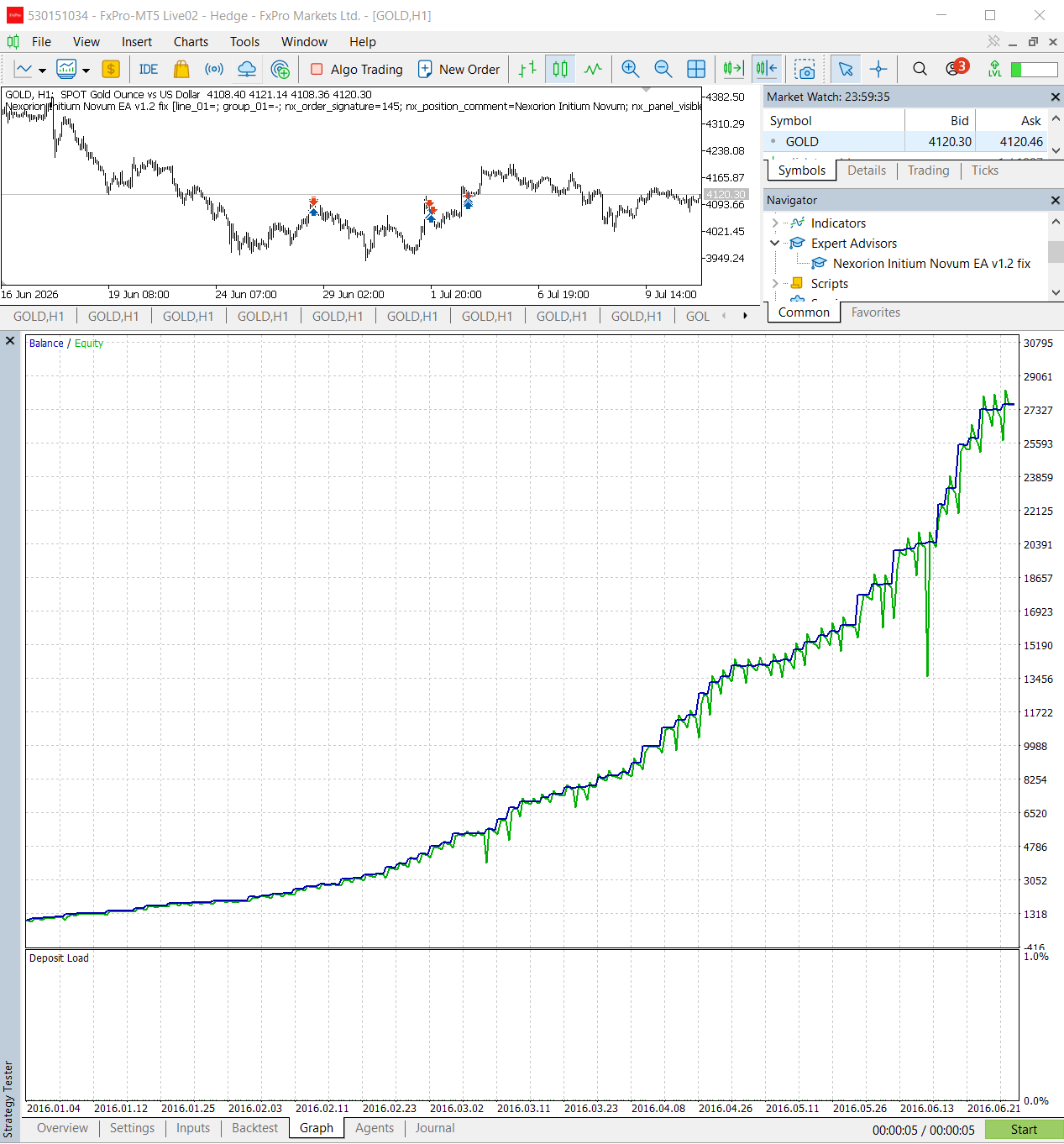
Most reports show 100% history quality; Nexorion’s 2016 report shows 96% where included. This is a tester data-quality field, not verification of broker fills. Complete risk inputs, dynamic sizing and all execution assumptions are not standardized across the products.
Gold House: June 2026
The matching June report shows 114 trades and 85.96% profitable trades. Relative equity drawdown reaches 22.93%. The balance retreats near the end of the chart, illustrating that breakout gains and subsequent losses can cluster even when the final period remains profitable.


Gold House: January–June 2026
The longer report shows 745 trades, 83.62% profitable trades and 36.46% relative equity drawdown. The $13.17 million-scale net profit is an exceptional historical account-growth outcome. Without an equalized sizing path, it cannot establish superior entry quality or an achievable live return.


Nexorion: January–June 2026
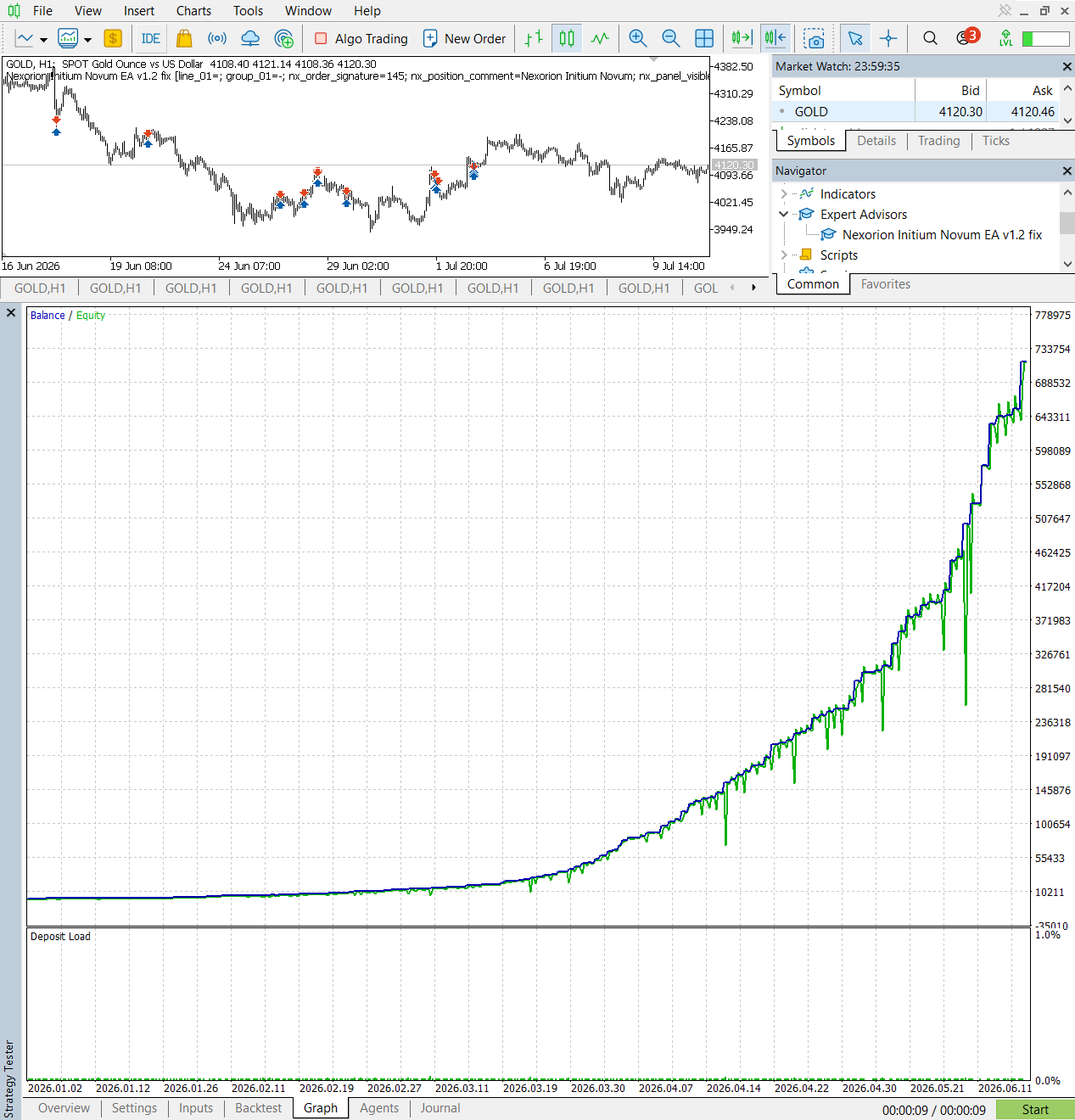
The source labels this recent six-month test. All 146 completed trades are profitable, while relative equity drawdown reaches 59.34%. The exceptionally large net profit is a sizing-sensitive historical outcome, not a target return. Inspect the equity line alongside the rising closed balance.
Nexorion: June 2026 Validation
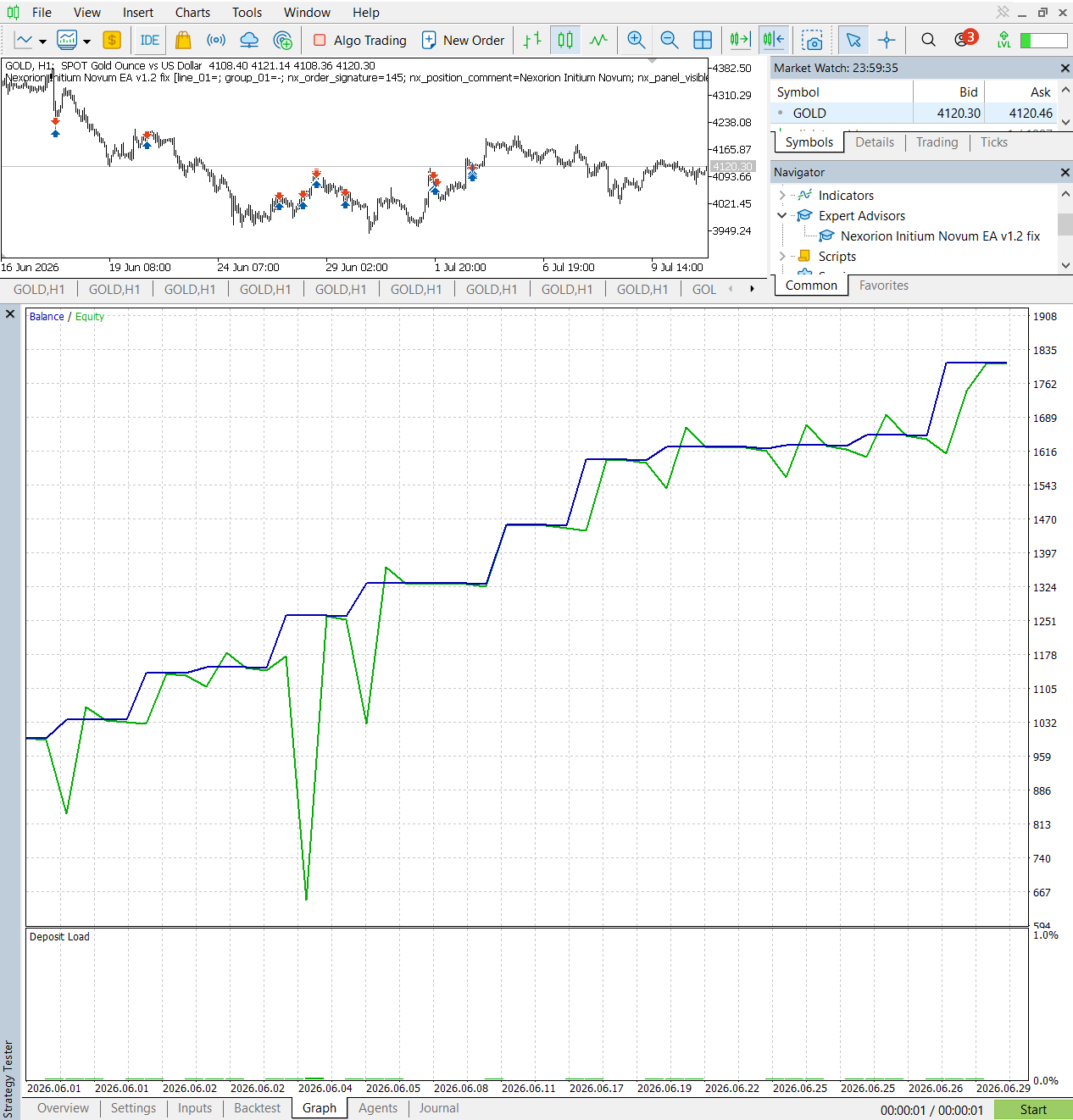
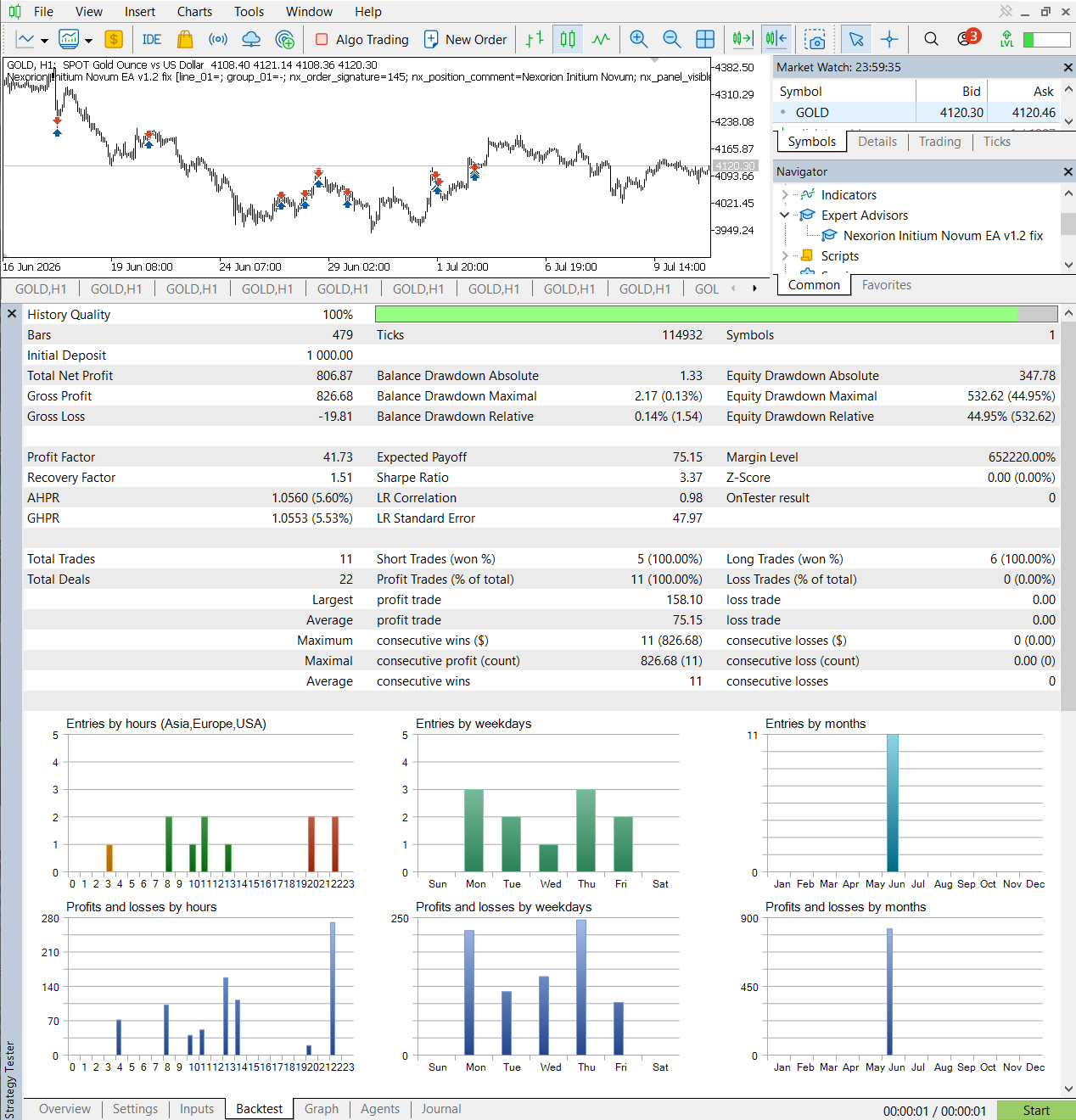
This shorter report contains 11 trades and $806.87 net profit, alongside 44.95% relative equity drawdown. June overlaps the longer recent test, so it is not an independent additional market regime. Eleven closures cannot establish a reliable future win-rate ceiling.
Nexorion: January–June 2016
The older-period test adds historical context: 85 completed trades, profit factor 28.31 and 35.42% relative equity drawdown. Its 96% history quality differs from the newer reports. A successful older sample does not establish an untouched out-of-sample process or eliminate selection bias.
Two No-Grid Descriptions, Different Equity Paths: What the Evidence Means
Both source reviews describe trading without grid or martingale, but that shared description does not specify equal risk. Gold House emphasizes five breakout modules, adaptive exits and partial closes. Nexorion emphasizes liquidity structures, equilibrium and deterministic validation. Neither description replaces a record of total open volume.
Nexorion’s recent longer test closes all 146 trades profitably while reporting 59.34% relative equity drawdown. Gold House’s longer report shows 36.46%. These are observations under separate historical configurations, not a forecast or a controlled ranking. The Nexorion result particularly demonstrates why a rising closed balance can coexist with large temporary account losses.
A useful follow-up compares how each configuration responds when its market interpretation is wrong. Record stop placement, amendments, holding time and concurrent positions. For Gold House, retain the chosen management priority and module set. For Nexorion, retain the tested version and sizing rule. A no-grid label removes no need to define an acceptable account-level loss budget.
A Reproducible Comparison on Your Broker
Choose the same gold contract, feed, capital, leverage and test dates. Save the exact EA build and SET file. Record the sizing method, active modules, stop distances and enabled management options. First compare at a restrained fixed exposure where supported, then examine any balance-based sizing separately.
Include spread, commission, swap and less favourable fills. Record simultaneous volume, margin level, time underwater and floating equity drawdown alongside closed profit. Repeat on an unseen period; do not optimize until the selected historical sample looks perfect. Shorter validation windows inside a longer test are not new independent data.
Keep a complete forward record of open positions, deposits, withdrawals and parameter changes. Selected screenshots help identify a bot but cannot establish a continuous audited track record. If both robots run on gold, assess their combined exposure rather than assuming different strategy names provide diversification.
Build MT5 EAs or copy trades between accounts
BYO-Bot is Windows software for building and testing MT5 strategies without coding. Free Edition exports eligible Single Position bots using standard exits with Loss Recovery off; premium export features require a paid licence. cTrader Copier offers free MT5-to-MT5 copying and MT5-to-cTrader copying with a paid subscription.
Gold House vs Nexorion Initium Novum EA: Frequently Asked Questions
Does Nexorion’s profitable-trade record prove lower risk?
No. The recent longer report combines 146 profitable closures with 59.34% relative equity drawdown. Closed-trade win rate and floating loss measure different things.
Do these screenshots establish live performance?
No. Historical reports are simulations. Forward screenshots are selected snapshots whose account type, completeness and settings need separate verification; shared-account totals are not standalone EA returns.
Which configuration should be tested first?
Start with a configuration whose sizing, stops and adverse-move response can be documented. Confirm contract specifications and setup on demo before considering limited live exposure. No label guarantees low drawdown.
Related Gold EA Research
Read the Gold House review and Nexorion Initium Novum EA review for full product context. For another management comparison, see Gold House vs Gold Snap and TwisterPro vs Gold House.
Verdict: Match the Configuration to the Risk Question
Gold House and Nexorion Initium Novum EA address gold trading through different described mechanics. Their tests offer useful questions about activity, exposure and exits without establishing a universal winner. Select a configuration you can reproduce and monitor, rather than the largest exceptional backtest balance.
Explore Gold House vs Nexorion Initium Novum EA
Review the product information and original settings before testing. Confirm the installed version and broker conditions; historical examples do not replace your own monitoring.
Risk Disclaimer
Gold, forex and leveraged CFDs can cause substantial losses. Past simulations and selected forward screenshots do not guarantee future results. Costs, feeds, sizing, execution and connectivity affect outcomes. Use only capital you can afford to lose. This article is educational information, not personalized financial advice.


